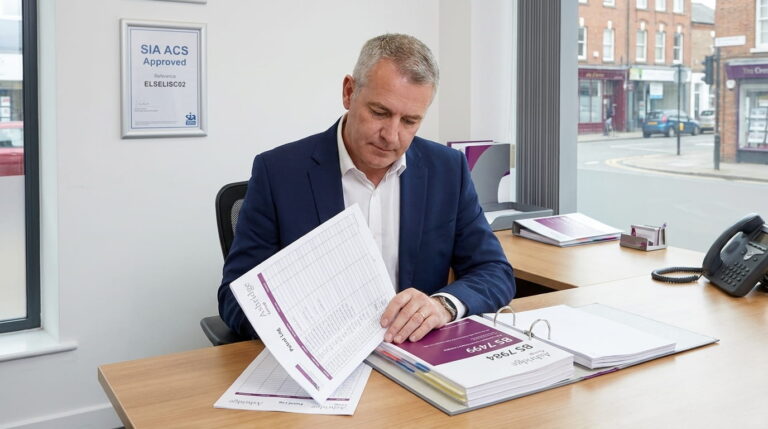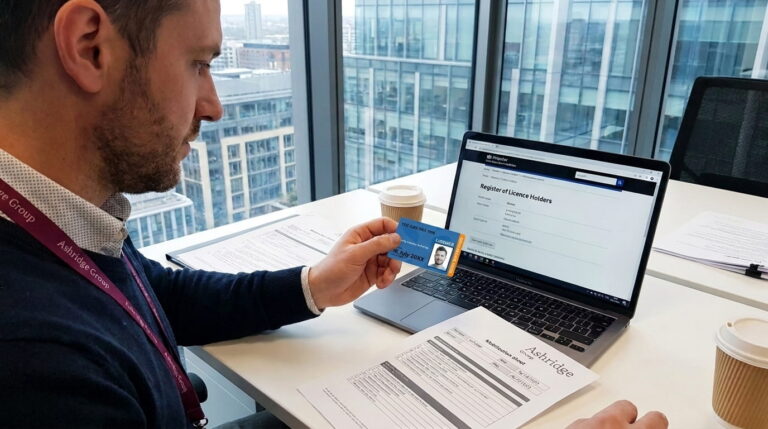
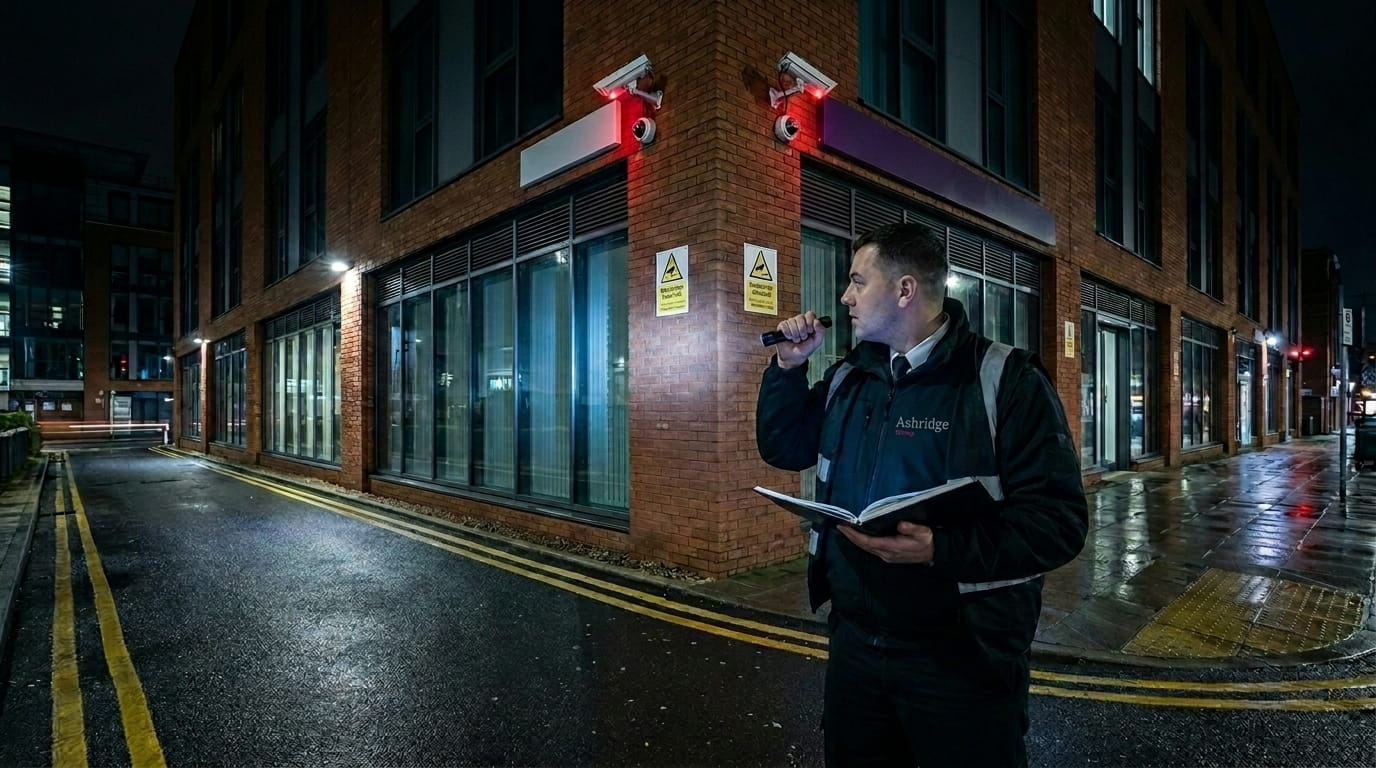

Security guard duties in the UK come from three documents, not from a job title: an SIA-issued frontline licence, a written assignment instruction approved by the provider and a site-specific risk assessment. The duties performed on any given shift are the duties written into those three, and they vary by site, by sector, and by the activity type the officer is licensed for. Ashridge deploys SIA-licensed, BS 7858-vetted officers on ACS Approved contracts across the UK, with each officer briefed to a written assignment instruction before the first patrol. This page sets out the core duties the SIA licence covers, the site-specific duties that vary by deployment, the training and vetting behind the licence, the difference between a static and a mobile officer, what the role pays and what it costs to deploy in 2026 and what to brief your provider before mobilisation.
What “Security Guard Duties” Actually Means in the UK
“Security guard” is a broad term the SIA does not define. The SIA defines six licence-linked activity types, from door supervision to cash and valuables in transit. The duties on any site depend on which activity the officer is licensed and briefed for. The SIA licence is the legal floor; the assignment instruction is the operational ceiling.
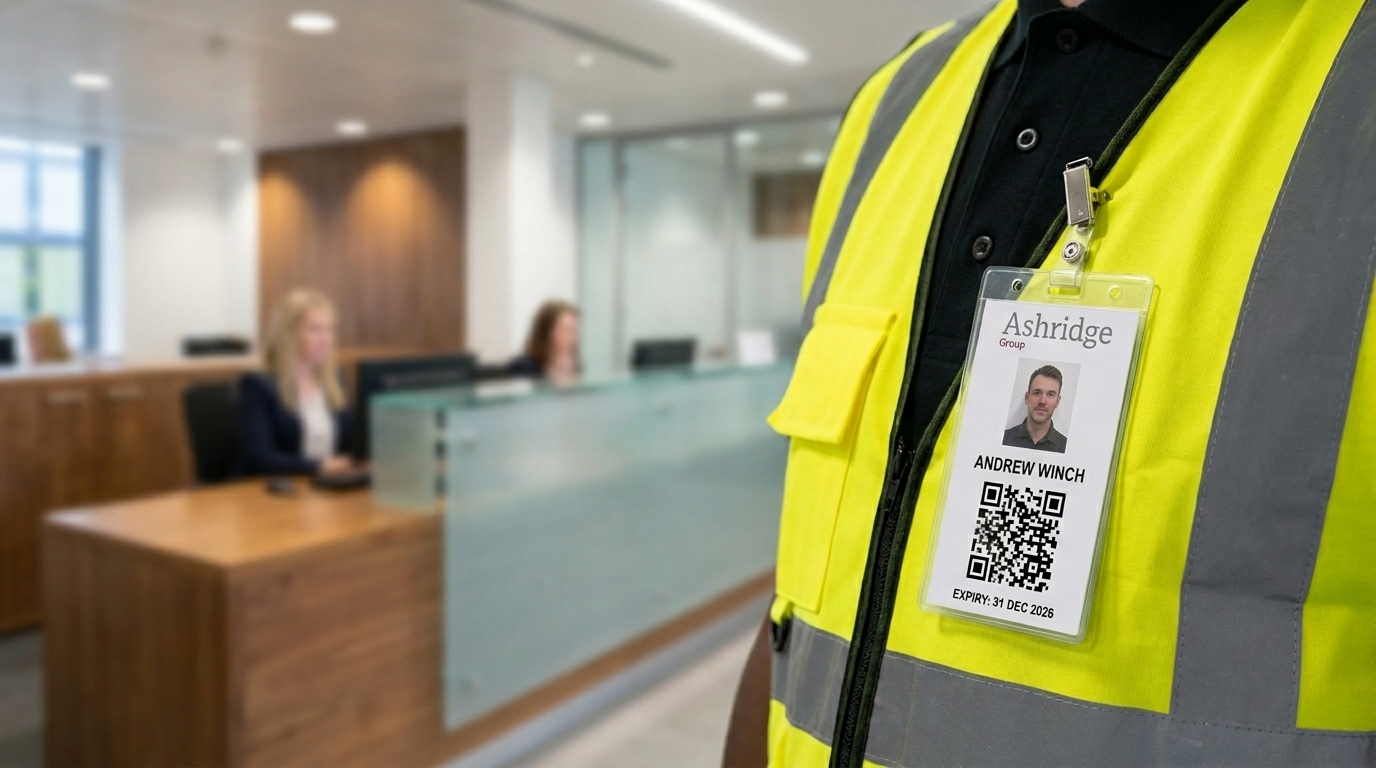
The SIA licence is the legal floor because it is the only document that authorises a person to work in a licensable activity for payment in the UK. The officer must hold a current SIA frontline licence for the activity they are performing, the licence must be displayed on the officer’s person (in practice, on their SIA badge), and the officer must be working for, or contracted to, an SIA-licensed or ACS Approved provider. Working without a valid licence in a licensable activity is a criminal offence under the Private Security Industry Act 2001, with fines for the officer and the provider.
The assignment instruction is the operational ceiling because it is the document that sets out the duties on this specific site, at this specific address, during these specific hours. A good assignment instruction names the patrol routes, the access points, the alarm response procedure, the escalation chain, the log format, the supervisor visit frequency, the site hazards, and the limits of the officer’s authority. An officer briefed only on a generic job description is operating below that ceiling and the provider’s insurance is the part at risk.
The Core Duties Required by an SIA Frontline Licence
The SIA’s “security guarding” licence covers core duties on UK static officer deployments: patrolling, access control, alarm response, incident reporting, and lawful exercise of a citizen’s powers. The licence does not cover door supervision, close protection, or CCTV monitoring, so an officer with only this licence cannot lawfully work a licensed venue door or a CCTV control room.
The five core duties the SIA “security guarding” licence is built around are:
- Patrolling. Foot patrols on a defined route at a defined frequency, with the route and frequency written into the assignment instruction. The route covers the building perimeter, the access points, the high-value or high-risk areas, and any area the risk assessment flags. Patrols are logged at the start point, at checkpoints, and at the end point.
- Access control. Management of pedestrian and (where briefed) vehicle access to the site: sign-in, ID check, visitor pass issue, contractor induction, and the refusal of access where the visitor or contractor does not meet the site’s criteria. The duty includes the physical opening and closing of gates, barriers, and doors on the published schedule or on instruction from the principal.
- Alarm response. Attendance at alarm activations, the assessment of the cause, the escalation to the key holder, the police, or the fire and rescue service as the assignment instruction requires, and the production of a written incident report. Officers are briefed to attend but not to enter a confirmed-break-in scene until the police arrive.
- Incident reporting. Written, dated, and timed records of every incident, escalation, and observation, with the report counter-signed by the principal’s site representative where the contract requires it. The incident report is the document the insurer, the SIA, the HSE, and the police will ask for after the fact.
- Lawful exercise of a citizen’s powers. A security guard is a private individual at law, not a police officer, and the powers the officer can lawfully exercise are the same as any member of the public: the power to prevent a crime in progress (citizen’s arrest) under section 24A of the Police and Criminal Evidence Act 1984, the power to remove a trespasser, and the power to ask a person to leave. The assignment instruction names the limits of these powers on this site.
Site-Specific Duties: Access Control, Patrols, and Alarm Response
The SIA licence sets the floor; the site-specific duties are written into the assignment instruction and the risk assessment. Three duties appear on most UK deployments in some form: access control, patrols, and alarm response. The depth of each depends on the site’s risk profile, the sector, and the hours of cover.
Access control is the most common duty on a static site, and the form it takes depends on the building type. On a corporate or commercial site, access control is typically a sign-in at reception with a photo ID check, a visitor pass, and an escort requirement for non-employees in operational areas. On a residential site, access control covers resident and guest entry, contractor induction, parcel handling, and the management of short-term lets where the building’s management policy requires it. On a construction site, access control covers the principal contractor’s induction process, the issue of personal protective equipment, the cross-referencing of every entry against the daily contractor list, and the immediate removal of anyone not on the list.
Patrols are written into the assignment instruction at a frequency the risk assessment justifies. The published industry default is hourly patrols for low-risk unoccupied sites, every 30 minutes for higher-risk sites, and every 15 to 30 minutes during live hot work, fire watch, or where the insurer’s wording specifies a tighter interval. The patrol route covers the building perimeter, the high-value areas, the plant rooms, the access points, and the fire exits; the patrol is logged at the start, at the checkpoints, and at the end of the round.
Alarm response is the third duty that appears on most deployments, and the form it takes depends on whether the officer is also the named key holder. On a single-officer static deployment, the officer may be the named first responder for the site’s intruder alarm or fire alarm out of hours, with a published escalation chain to the duty manager and the police or fire and rescue service. On a larger deployment, alarm response is the duty of a separate mobile patrol team with the keys, the response time contracted in minutes, and a written attendance log filed the morning after every activation.
What Training and Vetting an SIA-Licensed Officer Has
Every SIA-licensed officer has been through a four-stage process: right-to-work checks, criminal record checks, identity verification, and a licensed training qualification. The SIA’s top-up training requirement, introduced in October 2021, applies to all frontline licence renewals, with the first-line management and door supervision top-ups already in force.
The four stages are:
- Right to work. A right-to-work check against a UK passport, a settled status document, or a valid visa that permits employment in a licensable security activity. The provider keeps a copy on the officer’s personnel file.
- Criminal record check. A Basic Disclosure Scotland, an AccessNI check, or an enhanced DBS check, depending on where in the UK the officer is based and what the role requires. The SIA will refuse a licence to anyone with a relevant unspent conviction.
- Identity verification. The SIA’s identity check at the application stage cross-references the right-to-work documents, the criminal record check, and the training certificate. The officer’s photograph is held on the SIA’s online register and is the photograph on the SIA badge.
- Licensed training qualification. A regulated qualification (the Level 2 Award in Security Guarding for the “security guarding” licence, or a sector-specific Level 2 for door supervision) delivered by an SIA-approved training provider and confirmed by an externally marked examination. The qualification must be completed before the licence is issued.
Ashridge’s officers go further than the SIA minimum. Every officer is vetted to BS 7858 (the British Standard for security screening of personnel employed in a security environment), which covers the previous five years of employment, address, and character references. Every officer completes the in-house induction for the sector they are deployed in (construction, commercial, residential, void property, heritage) and is briefed on the assignment instruction before the first patrol.
Static Officer vs Mobile Patrol Officer: Different Duties
A static security guard works one site, on a fixed post, for the duration of the shift. A mobile patrol officer covers a defined round of multiple sites within a defined area, with each visit logged at the site. The duties overlap, but the format, the cost, and the kind of risk each one is best suited to are different.
A static officer is the right answer for sites with continuous access control requirements (a corporate headquarters, a residential block, a construction site with a single controlled entry), sites with on-site incidents that need an immediate in-person response (a void property with regular trespass, a heritage site with public footfall, a logistics yard with out-of-hours vehicle movements), and sites where the assignment instruction requires the officer to be on site for the full shift, not visiting on a route. The cost is a single officer rate for the full shift, with continuous cover for 24-hour sites built up from three or four officer shifts.
A mobile patrol officer is the right answer for lower-risk sites that need a visible security presence without the cost of a full-time officer: a row of vacant properties, a business park with out-of-hours intruder alarms, a portfolio of retail units, a district of automated industrial sites. The patrol officer visits on a contracted schedule (typically hourly, bi-hourly, or at randomised intervals), logs the visit, locks or unlocks the site on instruction, and reports any irregularity to the duty manager for escalation. The cost is a per-visit rate, often £19 to £25 per visit, which is materially cheaper than a full static officer for a site that does not need a continuous presence.
A blended deployment uses both: a static officer at the high-risk address and a mobile patrol at the lower-risk addresses in the same portfolio, with the static officer’s assignment instruction naming the mobile patrol as the out-of-hours response for any incident the static officer cannot cover alone.
What Security Guards Earn and What It Costs to Deploy One in 2026
A security guard’s hourly pay in the UK ranges from £13 to £15.50 per hour for an entry-level SIA-licensed officer, with experienced officers and specialist roles above that band. Deploying an officer costs more than the pay rate because it also covers vetting, training, supervision, insurance, uniforms, and the duty manager on call.
The published client charge rate range for security guarding in the UK in 2025–26 runs from approximately £19 to £40+ per hour, with the band driven by service type, sector, shift pattern, location and provider accreditation. The IPSA 2025 fair charge rate framework sets the minimum sustainable floor at £12.71/hr for a minimum-wage static officer. An entry-level static officer on a low-risk commercial site in a lower-cost region sits near the bottom of the band; a specialist officer on a high-profile night shift in London sits at the top. ACS Approved providers carry higher charge rates than non-ACS providers because the vetting standard (BS 7858), training requirements, supervisory overhead, and annual audit cycle all add demonstrable operational cost costs that a compliant contractor must recover to remain financially viable.
How to Brief Your Security Guard Provider
A good brief to your security guard provider covers five items: the site type and use class, the hours of cover, the access points, the risks to be managed, and the documentation already in place. The more specific the brief, the tighter the assignment instruction, and the lower the risk of a duty being missed on a quiet shift.
The five items are:
- Site type and use class. Commercial office, residential block, construction site, void property, heritage site, retail, industrial, healthcare, education, or public sector. The sector drives the sector-specific training the provider puts on the officer’s induction.
- Hours of cover. The days of the week, the start and end times, and whether the cover is continuous (single officer on a 12-hour rotation, 24/7) or scheduled (business hours only, with mobile patrol out of hours).
- Access points. The number of pedestrian entries, the number of vehicle entries, the loading bay, the fire exits, and any out-of-hours access requirement. The provider builds the patrol route and the access control duty from this list.
- Risks to be managed. Trespass, theft of plant, arson, vandalism, unauthorised access, void property squatting, public footfall, contractor non-compliance, or anything else the site risk assessment has flagged. Each risk translates into a specific duty on the assignment instruction.
- Documentation in place. The current site risk assessment, the fire risk assessment, the assignment instruction from the existing provider if any, the principal contractor’s site rules for construction sites, the management policy for residential blocks, and any insurer wording that names specific security requirements. The provider reads these before mobilising and builds the assignment instruction around them.
Ashridge works across the UK on SIA ACS Approved contracts, with named local officer coverage in cities including London, Manchester, and Birmingham. For the published cost ranges for a static officer deployment, see our manned guarding cost UK guide.
See also: Ashridge manned guarding services.