
A security risk assessment has no standard price in the UK. Cognitious, the security consultancy of Ashridge Group, prices each security threat and risk assessment after scoping the site, and we publish no price list or day rate. We have not found a public, dated source for UK price ranges that we could cite, so this guide gives none.
The fee follows the consultant time the work needs. That time is set by the size and number of sites, the systems and procedures reviewed, the depth of the report, who does the work, when the consultant can get access, the constraints and people to consult, and travel. To compare quotes, write one scope and send the same scope to every consultancy. A lower fee for a thinner scope is a different purchase, not a saving.
What drives the price of a security risk assessment
Eight factors change the time a security risk assessment takes, and so its fee. Ask each consultancy the question in the third column, and compare the answers before you compare the totals.
| Factor | Effect on the fee | What to ask the consultancy |
|---|---|---|
| Size and layout of the site | More buildings, floors, entrances and perimeter take longer to walk and to write up | How many days on site does the quote allow, and which areas do they cover? |
| Number of sites | Each site needs its own visit and its own findings | Is every site visited? Is there one report, or one for each site? |
| Systems and procedures reviewed | CCTV, access control, alarms, lighting, and reception, visitor and contractor procedures each add review time | Which systems and procedures are reviewed, and which are left out? |
| Depth of the report | A short summary of findings takes less time to write than a full report with prioritised recommendations and an implementation plan | What will the report contain? Can we see the contents page of a past report? |
| Who does the work | A senior consultant’s time costs more than a junior’s, so the mix changes the total | Who visits the site, and who writes the report? |
| Access and timing | Visits at night, at weekends or in phases around your operations add time, and may be charged at a different rate | Does the site need to be seen out of hours, and is that visit priced? |
| Constraints and people to consult | A listed building, public access or an events programme adds questions to answer, and each person or group the consultant must interview adds time | Who will you need to speak to, and which constraints have you allowed for? |
| Travel | Travel time and expenses grow with distance and with the number of visits | Is travel inside the fee, or charged separately? |
Two of these rows have a Cognitious answer already. Our own in-house consultants carry out the assessment, and we do not subcontract it. On constraints, Delapré Abbey’s Grade II listing constrains what can be installed and where, and a survey of a listed site has to start from what the listing permits.
What the fee pays for: four stages of consultant time
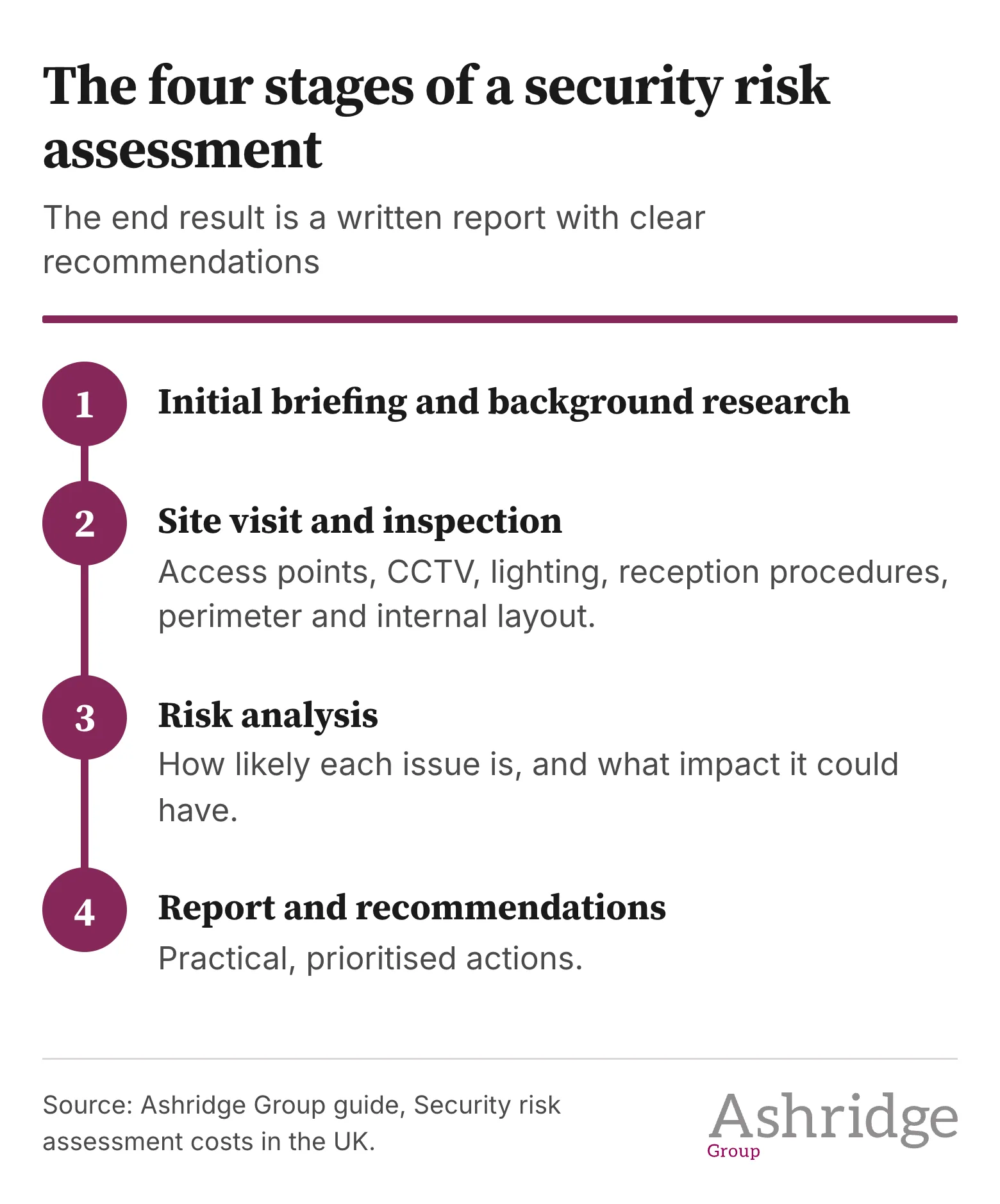
A security threat and risk assessment identifies the threats, vulnerabilities and risks to your people, assets, operations and reputation, and ends in recommendations. The work usually has four stages: a briefing and background research, a site visit, the risk analysis, and the report. Only the site visit happens in front of you, so ask for the days allowed for each stage.
 (opens the full-size image)
If you have not yet decided whether you need a consultant at all, start with our guide to what security consultancy is.
What a written scope should contain so quotes are comparable
Write the scope yourself, or have the first consultancy write it and then send that document to the others. A scope that lets you compare quotes states nine things:
- The sites. Each address and building covered.
- The reason. The concern, incident, insurer request or change of use that prompted the assessment.
- What is reviewed. The perimeter, access points, CCTV, access control, alarms, lighting, and reception, visitor and contractor procedures, with anything excluded named.
- Who does the work. The consultant who will visit the site and the consultant who will write the report, by name.
- The site visits. How many, how long, and whether any are out of hours.
- The deliverable. What the report contains, how recommendations are prioritised, whether it includes an implementation plan, and that you keep the documents produced.
- Reviews. How many rounds of comments on the draft are included, and whether the consultant presents the findings to your board or client.
- The timetable. Dates for the visit, the draft and the final report.
- The fee. The basis of the fee, whether it includes VAT, and every exclusion.
Fixed fee, capped time, retainer or call-off: how consultancies charge
Consultancy work is commonly charged in four ways. For one site with a settled scope, ask whether a fixed fee is available. The other three fit when the scope is still open or the work continues after the report.
| Fee structure | What it means | Fits when |
|---|---|---|
| Fixed fee | One price for a defined scope and deliverable | You have one site and a settled scope |
| Time charged, with a cap | You pay for the days worked at a stated day rate, up to an agreed maximum | The scope is not settled, for example before anyone has walked the site |
| Retainer | A set fee each month or year for agreed ongoing support | You need continuing advice after the assessment |
| Call-off | Each assessment is ordered under terms agreed once, in advance | You have a portfolio and assess its sites one at a time |
A fixed fee is fixed only for the scope it was quoted against. If the scope may move, agree in advance how a change is priced.
What is and is not included: travel, re-visits and follow-on work
None of the items below is unreasonable to charge for. Each should be stated in the quote before you accept it, because each can change the total after you have chosen a consultancy on price.
- Travel and accommodation. Ask whether they are inside the fee or charged at cost, and whether travel time is charged.
- Re-visits. Ask what a second visit costs, whether to see the site at night or during an event, or to check progress after the report.
- Changes of scope. Ask how an added building or system is priced once work has started.
- Extra review rounds and presentations. Ask how many rounds of comments are included, and whether presenting the findings is.
- A change of consultant. If the quote names a consultant, ask for your agreement to be required before anyone else is substituted.
- Follow-on work. A security risk assessment ends with recommendations. Acting on them is separate work: writing procedures, training staff, physical penetration testing, or putting security officers on site.
Cognitious is part of Ashridge Group, which supplies security officers. Where a Cognitious review recommends guarding, patrols or monitoring, Ashridge Group can deliver it, and that is a separate piece of work from the assessment. If a recommendation involves officers, our manned guarding cost guide gives the hourly rates. Ask any consultancy that is linked to a supplier, ours included, how it keeps its recommendations separate from what the group sells.
Six pieces of work for one client: Delapré Abbey
Delapré Abbey shows how much work can sit alongside a survey. The Abbey is a Grade II listed heritage site in Northamptonshire and a registered battlefield. It is used for events, weddings, and corporate and private hire, with more than 10 permanent staff and around 100 volunteers. Cognitious began supporting the Delapré Abbey Preservation Trust in 2016, and the Delapré Abbey case study records six pieces of work:
- A security survey of the site, with a full report.
- A security strategy and technical solutions document.
- A 150-page health and safety policy, written after consultation with stakeholder groups and representatives of the local authority, and compiled into a procedures manual.
- Familiarisation training for the Trust.
- Ongoing health and safety support, including a designated Competent Person acting for the Trust.
- A review of the Abbey’s own risk assessment for a Halloween event that used specialist equipment.
Only the first item, the security survey, is the kind of work this guide prices. If you expect to need more than the first, say so when you ask for quotes, and have each piece priced as its own line. The case study does not give fees, and we do not give them here.
What to send Cognitious for a quote
Cognitious needs five things to scope a security threat and risk assessment:
- The address or postcode of each site.
- The type of site, and how it is used.
- The reason you need the assessment.
- The deliverable you need, and who will read it.
- The date you need it by.
Call 0800 085 5022 or send us the details. We reply within one working day. If you are comparing several firms, our guide on how to choose a security consultancy lists the checks to make on each one.
Frequently asked questions
No law requires a security risk assessment by that name. Employers must assess the health and safety risks to their employees, and to other people affected by their work, under regulation 3 of the Management of Health and Safety at Work Regulations 1999. Martyn's Law, which is not yet in force, will place duties on those responsible for certain premises where 200 or more people, including staff, may reasonably be expected to be present at the same time. The Home Office says its guidance is designed to be followed without third-party services.
No. A fire risk assessment is a separate legal duty on the responsible person under article 9 of the Regulatory Reform (Fire Safety) Order 2005. Government guidance says that if you do not have the expertise or time to do it yourself, you need to appoint a competent person to help, for example a professional risk assessor. Cognitious does not write fire risk assessments.
No. A security threat and risk assessment reviews the threats, vulnerabilities and risks to a site and recommends what to change. A physical penetration test is a controlled, simulated attempt to reach restricted parts of the site, to check whether the measures work in practice. Cognitious carries out both. Its penetration testing is physical only, not cyber.
With Cognitious, you keep it. The client keeps the plans and procedures Cognitious produces, so you can act on the recommendations with your own team or put the work out to tender. Ask any consultancy to confirm this in the written scope before you sign.