
If you are organising an event in the UK and hiring a security company, its staff must hold the right SIA licence for the work they will do, and you should check that they do before the event.
Under the Private Security Industry Act 2001, doing licensable security work without a licence is a criminal offence, and section 5 makes it an offence for a company to supply security services using an unlicensed operative. The offences fall on the unlicensed individual and the supplier, not on you as the customer, but an unlicensed team puts your event, your insurance and your premises licence conditions at risk.
This guide covers what you need to check, why it matters, and how to verify you are compliant.
The legal requirement
The Private Security Industry Act 2001 requires an SIA licence for licensable security work carried out under a contract, which covers almost all event security supplied by a security company. Staff employed directly by a venue generally do not need one, except door supervisors at licensed premises.
For event security specifically, the relevant SIA licence categories are:
Door Supervisor — the most common licence for event security staff. Covers door supervision, access control, and conflict management at events where the primary risk is crowd management and confrontation at entry and exit points.
Security Guard: guarding premises, property or people where the work is not door supervision, such as overnight security of an event site before and after opening hours.
Close Protection — required for events where officers are assigned to protect specific individuals, such as corporate events with senior executives, high-profile speakers, or celebrities. Close protection is a separate and more specialist licence.
The Security Industry Authority (SIA) is the statutory regulator for the private security industry across the UK. It issues licences, enforces the Act, and maintains the public register of licensed security personnel.
If a security company sends staff to your event who are not correctly licensed, the individuals and the company commit offences under the Act. Checking each licence on the SIA register yourself is the way to make sure that does not happen at your event.
Which licence category applies
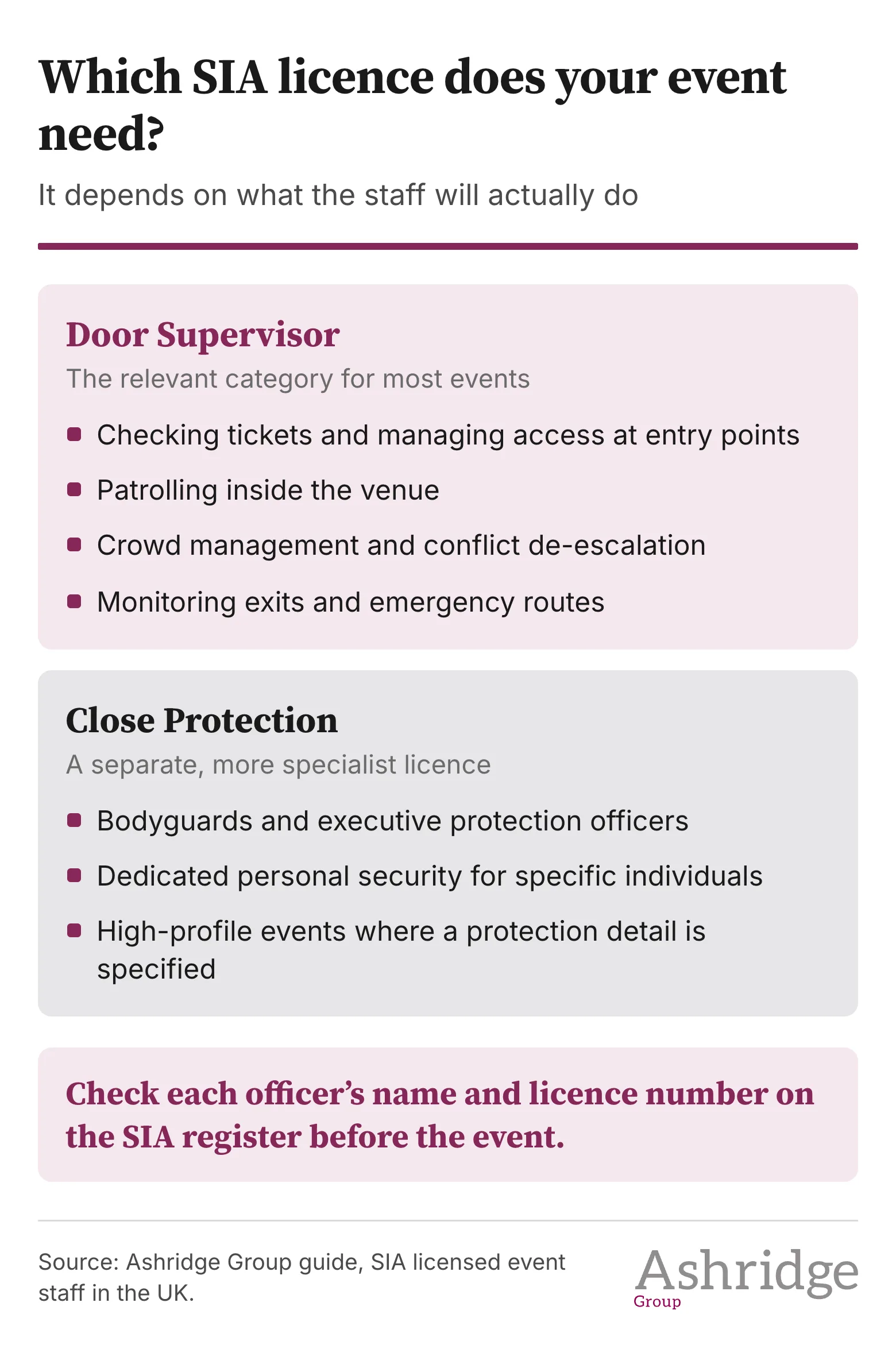
The licence category your event requires depends on the nature of the event and what your staff will actually be doing.
Door Supervisor licence applies to:
- Staff checking tickets and managing access at entry points
- Officers patrolling inside the venue
- Crowd management and conflict de-escalation
- Monitoring and managing exits and emergency routes
- General site security across most event types
Close Protection licence applies to:
- Individual bodyguards or executive protection officers
- Events where specific individuals require dedicated personal security
- High-profile corporate events, awards ceremonies, or private functions where protection detail is specified
For most events — music festivals, sports fixtures, corporate conferences, trade shows, community events — the Door Supervisor licence is the relevant category.
If you are unsure which licence category applies to your event, ask the security provider to confirm before you sign a contract.
 (opens the full-size image)
How to check the SIA register
The SIA maintains a public register of all licensed security personnel in the UK. Before your event, you should ask the security provider to confirm the names and licence numbers of the officers who will be on your site. You can then verify each one on the SIA website.
The register confirms:
- That the licence is current and not expired
- That the licence category matches the role the officer will perform
- That the officer has no prohibitions from working in the security industry
A security company that cannot provide licence details in advance, or whose staff do not appear on the register, should not be used. It is a straightforward indicator that the company is not properly managed.
Checking the register takes five minutes per officer. For events with a significant number of security staff, ask the security provider to supply a pre-event briefing document listing all officer names, SIA licence numbers, and the roles they will perform on site.
ACS Approved vs individual licensing
A security company can hold ACS Approved status (the SIA’s Approved Contractor Scheme) independently of whether its individual staff hold SIA licences. Both matter.
The ACS Approved scheme assesses a company against criteria including:
- Staff training and vetting standards
- Operational procedures and management structure
- Financial stability and business continuity
- Customer complaint handling
For event organisers, ACS Approved status tells you that the company itself has been independently assessed. It does not replace the need to verify individual officer SIA licences.
Both should be checked. A company with ACS Approved status that cannot demonstrate valid SIA licences for its staff is not a compliant provider.
What to ask your security provider
Before you commit to a security provider for your event, ask these questions:
1. What SIA licence category do your officers hold?
Confirm the Door Supervisor or Close Protection category matches your event requirements.
2. Can you provide a pre-event officer list with SIA licence numbers?
A professional provider will supply this. It is the minimum you should expect.
3. How can I verify the licence numbers on the SIA register?
Ask how the provider confirms each licence before a shift. A provider that will not tell you should not be used.
4. Does your company hold ACS Approved status?
Ask for the certificate and check the company on the SIA’s online register of approved contractors.
5. What training do your officers receive beyond the SIA licence requirement?
Conflict management, first aid, and event-specific training are standard for professional event security providers.
6. How do you manage last-minute staffing changes?
If an officer cancels, how does the provider ensure a licensed replacement arrives without gaps in coverage?
7. What is your policy on expired or invalid licences?
A professional provider will immediately remove any officer found to be working without a valid licence.
Why compliance matters
The consequences of deploying unlicensed security staff at a UK event are not abstract.
Under the Private Security Industry Act 2001, working without a licence and supplying unlicensed staff are criminal offences for the individual and the security company. If an incident occurs and the security staff at your event turn out to be unlicensed, that is a problem a register check would have prevented.
Beyond the legal risk, unlicensed staff are typically less well-trained, less well-vetted, and less professionally managed. They represent a higher risk to your event, your attendees, and your reputation.
Professional SIA-licensed officers are a direct cost, but they are also a direct reduction in your event’s legal and operational risk.
What Ashridge Group provides
Ashridge Group provides SIA-licensed event security staff across the UK, covering door supervision, access control, crowd management, and executive protection roles.
All of our event security officers hold valid SIA Door Supervisor or Close Protection licences as appropriate for their assignment. We supply pre-event officer briefings with full licence details so you can verify each name on the SIA register before the event begins.
Recent event work includes a open-air cinema screening for Walton Community Council and a multi-day schools athletics event at Stantonbury, and we provided security at Milton Keynes Theatre for seven years.
We hold SIA ACS approval for security guarding and ISO 9001 certification. Our event security teams include officers with specialist training in conflict de-escalation and crowd management.
To discuss your event security requirements, contact Ashridge Group.
Frequently asked questions
Not for stewarding duties alone. The SIA says no licence is needed to direct people to their seats, toilets or first-aid facilities. A steward supplied under a contract who guards the event against unauthorised access, theft, damage or disorderly behaviour is doing licensable work and needs the right SIA licence.
A door supervisor licence is needed to guard licensed premises, which means a venue licensed to sell alcohol for drinking on site or to provide regulated entertainment. At an event with neither, contracted security staff need a security guard licence. A door supervisor licence also covers security guard work, so door supervisors can work at both kinds of event.
No, if they are genuine volunteers. The SIA says a volunteer does not need a licence as long as there is a written or spoken agreement that they will receive no payment or reward for the work. Anyone paid or rewarded for licensable security work under a contract needs a licence.
Yes. A front line SIA licence holder must wear the licence where it can be seen at all times during licensable work, unless it has been reported lost or stolen or the SIA is holding it. Where the job requires that an officer is not identifiable, as in some close protection work, the officer must still carry the licence and produce it on request.
The Terrorism (Protection of Premises) Act 2025, known as Martyn's Law, will apply to qualifying events where 800 or more people, including staff, are expected to be present at the same time. It received Royal Assent on 3 April 2025 and is not yet in force: the government expects an implementation period of at least 24 months. The SIA will be the regulator, and the duties will fall on the person responsible for the event.