

Risk management consultancy has no standard price in the UK, because the work runs from one site’s risk register to a rolling programme across a portfolio. What you pay depends on who does the work, how settled the scope is, which standards the work follows and what the quote leaves out.
This guide does not publish hourly or day rates. We could not find a public, dated source for them, and an unsourced rate band would mislead you. It covers the cost drivers, the four contract structures and the hidden costs, so you can compare quotes like for like.
Cognitious, the consultancy arm of Ashridge Group, scopes engagements against BS 31100:2021 and ISO 31000:2018. BS 31100:2021 is the British code of practice for risk management, and ISO 31000:2018 is the international guidance it supports. We hold SIA Approved Contractor Scheme (ACS) approval (SIA reference ELSELISC02) for our guarding, and we are certified to ISO 9001, ISO 14001 and ISO 45001.
What decides the cost of risk management consultancy?
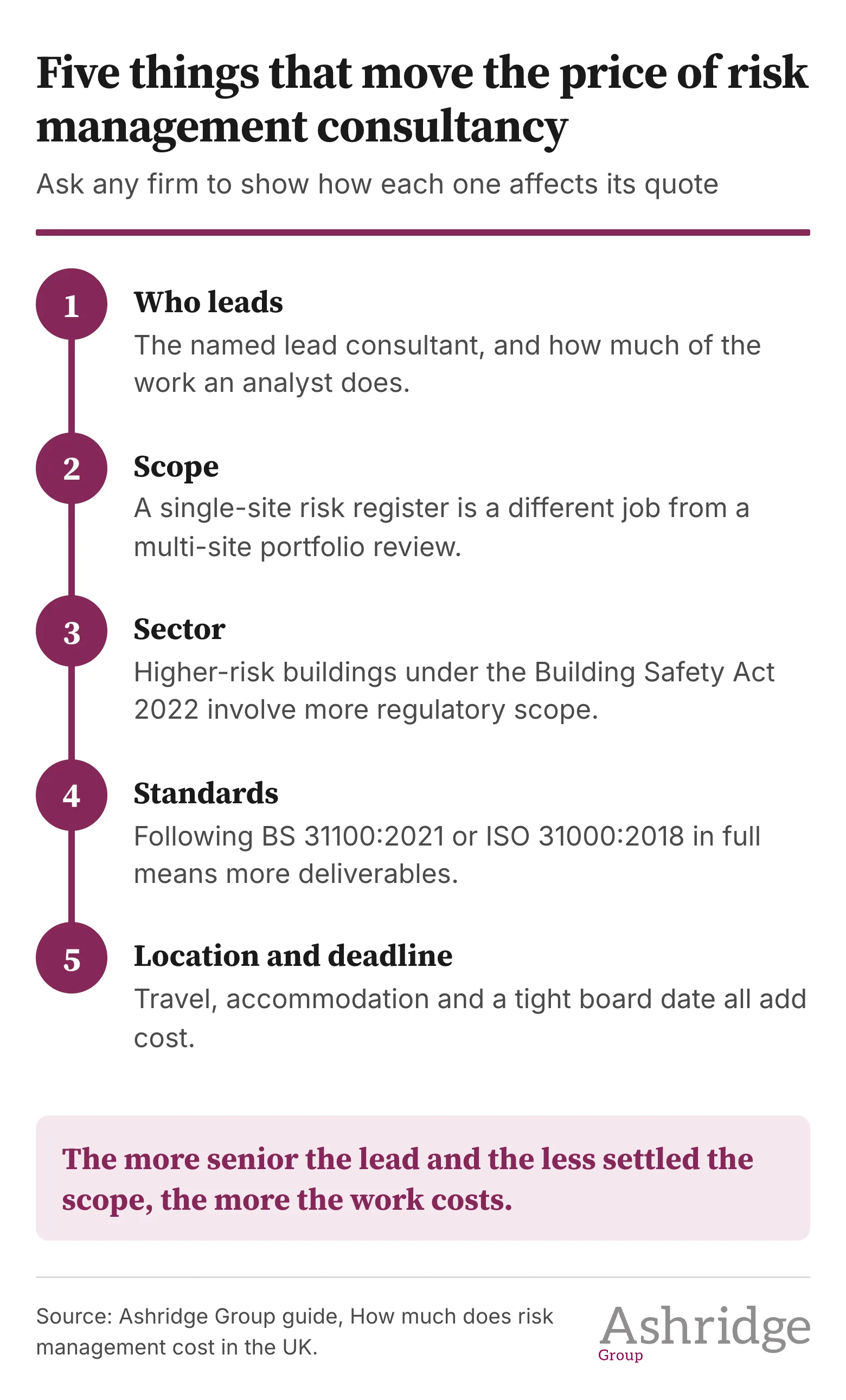
Five things move the price: the seniority of the person leading the work, the scope, the sector, the standards followed and the deadline. The more senior the lead and the less settled the scope, the more the work costs. Ask any firm to show how each one affects its quote.
- Who leads. The named lead consultant is the senior person named in the quote who leads the work. An analyst supporting them costs less per hour, so the mix of the two changes the total.
- Scope. A single-site risk register (a list of the risks to a site, each with an owner and a response) is a different job from a multi-site portfolio review. Say clearly what is in and what is out.
- Sector. Work on higher-risk buildings under the Building Safety Act 2022 (buildings in England at least 18 metres tall or with 7 or more storeys, containing at least two residential units) involves more regulatory scope, so it usually takes more work.
- Standards. Following BS 31100:2021 or ISO 31000:2018 in full means more deliverables than a short advisory note.
- Location and deadline. Travel, accommodation and a tight board date all add cost. Ask whether travel is included or billed separately.
 (opens the full-size image)
What are the four contract structures?
UK risk management contracts come in four shapes: time-and-materials with a fee cap, fixed fee, annual retainer and framework call-off. Match the structure to how settled your scope is. The more the scope may move, the more you want a cap on the total.
| Structure | What it means | Fits when |
|---|---|---|
| Time-and-materials with a fee cap | You pay for time spent, up to an agreed maximum | The scope is not yet fully defined |
| Fixed fee | One price for a defined deliverable | A single-site engagement with a clear scope |
| Annual retainer | A set fee for a rolling review cadence, with a right to swap the named lead | You need regular reviews through the year |
| Framework call-off | You order each piece of work under a pre-agreed contract | Your team runs several engagements a year |
What hidden costs move the invoice?
Five items most often change the price of a fixed-fee engagement: re-scoping, a swapped consultant, travel, extra reviews and formatting. None is unreasonable if it is agreed upfront. Each one should be written into the quote or the contract before you accept it.
- Re-scoping after kick-off. A change of scope re-prices the engagement. Ask how changes are priced.
- A junior consultant where the quote named a lead. Write out of the contract any swap of the named lead without your agreement.
- Site visits outside Greater London. These are often billed separately, plus travel time. Check the quote states which.
- Extra reviews. Ask how many review cycles are included. Further rounds are often charged.
- Board-ready formatting. Some firms price it as an extra.
How do you compare two risk management quotes?
Compare quotes on the same basis: the named lead and their hours, the standards followed, the deliverables, the number of review cycles, and exclusions such as travel and board-ready formatting. A lower hourly rate can cost more in total if reviews, travel or formatting are priced separately.
ISO 31000:2018 is guidance rather than a certifiable standard, so ask each firm what following it means in the deliverables.
What this looks like on a real contract. Cognitious, an Ashridge Group company, delivered heritage site security at Delapré Abbey: a security survey, a security strategy and a 150-page health and safety policy for a Grade II listed, registered battlefield site, with two years of ongoing support as the designated Competent Person.
What to send for a fixed-fee quote
A supplier needs six items to price accurately:
- Site address and sector.
- The trigger event, such as an insurer audit, new tenant, planning consent, Building Safety Act 2022 regime, board review or incident.
- The engagement scope.
- The named lead you expect, if you have a preference.
- Who signs off the work.
- The board deadline.
If you want a second opinion on a risk management quote, send it to us with those six items. Cognitious will read it and tell you what is missing, or scope a fixed-fee proposal. Call 0800 085 5022 or email [email protected].
Sources
- BS 31100:2021 Risk management: code of practice and guidance for the implementation of BS ISO 31000 – BSI
- ISO 31000:2018 Risk management: guidelines – ISO
- Building Safety Act 2022, section 65 – legislation.gov.uk
Frequently asked questions
Both are used. Fixed fee suits a fully defined scope such as a single-site risk register. Time-and-materials with a fee cap suits a scope that is still moving. Whichever you choose, ask for the named lead, the hours, the deliverables and the exclusions in writing so quotes can be compared.
Three things move the price most: the named lead versus an analyst, the sector and the location. Work on higher-risk buildings under the Building Safety Act 2022 involves more regulatory scope. Travel outside the firm's base is often billed separately.
Practice varies. Some fixed-fee quotes include travel within Greater London and bill travel and accommodation separately beyond it. Check that the quote states which, and get it in writing.
Yes. Under the Private Security Industry Act 2001 the SIA licenses security guarding, door supervision, close protection, cash and valuables in transit, public space surveillance (CCTV) and key holding, plus vehicle immobilising in Northern Ireland. Risk management consultancy is not a licensable activity, so it sits outside SIA scope. That is why our ACS approval covers our guarding and not Cognitious advice. Consultants may hold professional registration (such as RSES for protective security specialists), and engagements typically reference BS 31100:2021 and ISO 31000:2018.