

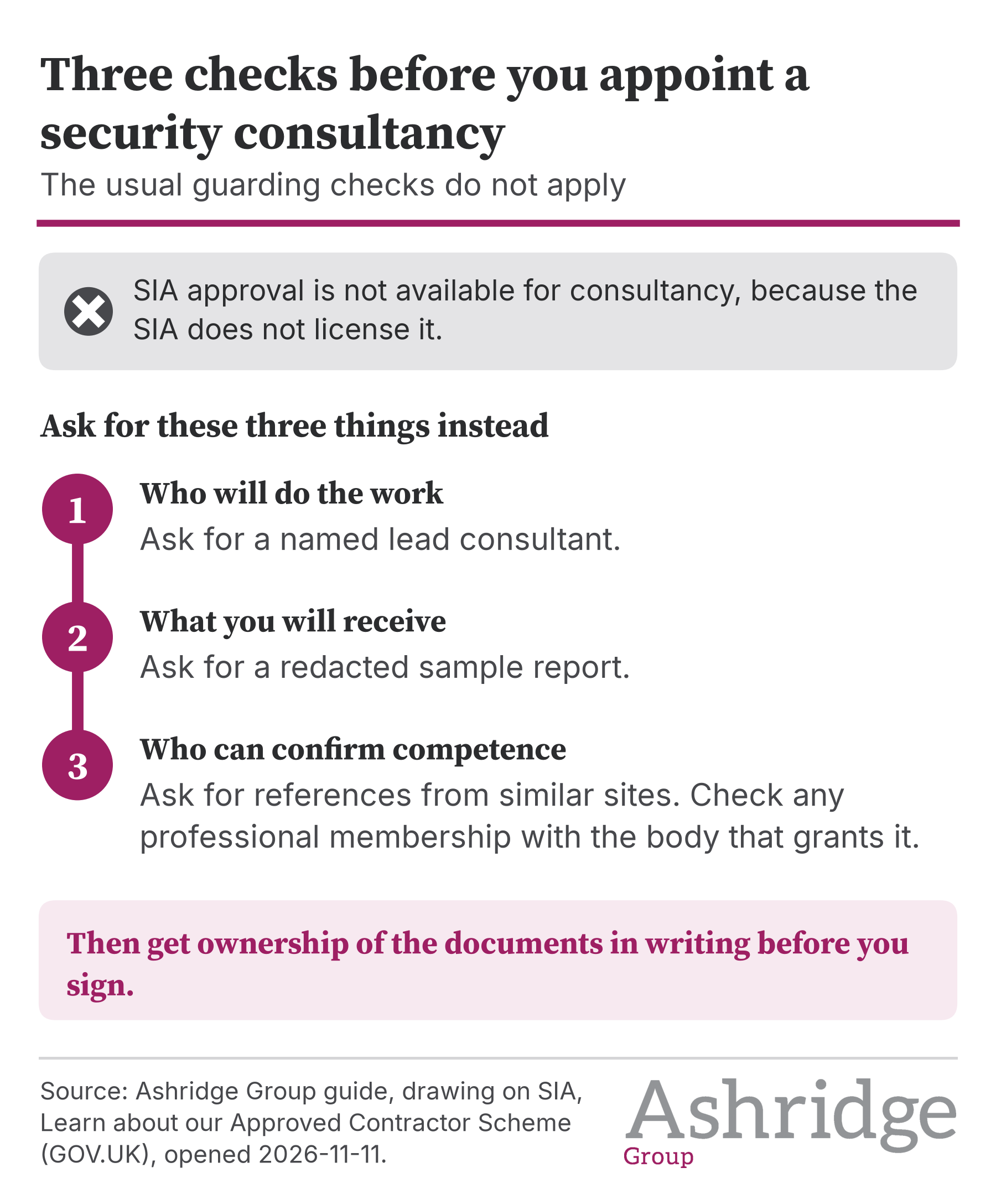
Choose a security consultancy on three things you can check yourself: who will do the work, what you will receive, and whether anyone independent can confirm the consultant’s competence. The Security Industry Authority (SIA) neither licenses nor approves security consultancy, so the checks you would use on a guarding company will not help you here. Ask for a named lead consultant, a redacted sample report and references from similar sites, and get the ownership of the documents in writing before you sign.
Cognitious, an Ashridge Group company, delivers security threat and risk assessments, proactive security reviews, physical penetration testing and emergency preparedness through its security consultancy service. This guide applies to any firm you are considering, Cognitious included. For what a consultancy does and when to hire one, see What Is Security Consultancy?. For what the work costs, see the security risk assessment cost guide.
Which usual checks do not apply to a consultancy?
The checks you use on a guarding supplier do not transfer. The SIA runs the Approved Contractor Scheme (ACS) for private security companies, and says it can approve a company for close protection “but not for installing alarms or providing consultancy services because we do not license those activities” (SIA, Learn about our Approved Contractor Scheme). A consultancy will not appear on the register of approved contractors. If a consultancy shows you an ACS approval, it relates to a guarding or key holding arm, not to the quality of its advice.
ISO 31000:2018 is the usual risk management reference, but ISO states it is “not a certifiable risk management standard” (ISO 31000). A firm that says it is “ISO 31000 certified” is wrong, or means something else. Ask which method the firm uses and how it applies ISO 31000, and ask to see that in a sample report.
What can you verify independently?
Verify the person, not the logo. The Association of Security Consultants (ASC) states on its find-a-consultant page that its listed consultants are “vetted and peer reviewed by the ASC to ensure they are appropriately qualified or experienced” (ASC). That is the ASC’s own description, and membership is not a requirement to practise, so treat it as one route to independent evidence, not a pass mark. Ask the consultant who would lead your engagement which independent route they hold, and check it with that body, not on the consultant’s say-so.
What should you ask in the first meeting?
| Ask | A good answer | A warning sign |
|---|---|---|
| Who visits the site and who writes the report? | One named lead consultant, with any others named and their role stated. | “Our team” with no names. |
| What will I receive? | A described deliverable and a redacted sample of a comparable one. | No sample, or a sample from a different type of work. |
| Which method do you use? | A named method and how it is applied, shown in the sample. | “ISO 31000 certified”. |
| What have you done on sites like mine? | Two references from comparable sites that you can call. | Sector claims with no reference. |
| What will you not cover? | A stated boundary: for example, that installation or monitoring is not part of the advice. | “Everything.” |
| Do you or a sister company sell guarding or systems? | A direct yes or no, and how recommendations are kept separate. | A vague answer, or none. |
The last row matters most in a group that also supplies security. Cognitious is part of Ashridge Group. Its service page says recommendations for manned guarding, mobile patrols, key holding or event security can be delivered by Ashridge Security, and that the strategy, procedures and exercise plans the review produces are the client’s to keep and run, whoever delivers the measures (Cognitious). That is a disclosure you are entitled to ask any firm for.
What does good practice look like in a real engagement?
The consultancy should look before it writes. At Delapré Abbey, a Grade II listed heritage site in Northamptonshire, Cognitious carried out a security survey, then a full report and a security strategy and technical solutions document. After consultation with stakeholder groups and representatives of the Local Authority it wrote a 150-page health and safety policy and procedures manual, supplied digitally and in hard copy with familiarisation training. The Abbey Trust has used Cognitious on an ongoing basis for two years, with a designated Competent Person acting on its behalf (Delapré Abbey case study). Whatever firm you choose, expect the sequence: survey, then findings, then the documents you will run yourselves.
What should the contract say?
Get these in the signed contract, not only in the proposal. This is good practice, not legal advice: take legal advice on liability terms before you agree them.
- Scope and deliverables. What is delivered, in what form, by when. Any change to scope should need your written agreement.
- Named lead consultant. Substitution only with your written consent, so the person you vetted is the person who writes the report.
- Fee basis. Say whether the fee is fixed per deliverable or charged by day, and whether travel and subsistence are included. For what drives the fee, see the cost guide.
- Ownership of the report and the plans. If you want ownership rather than a licence to use, the transfer must be written down and signed: “An assignment of copyright is not effective unless it is in writing signed by or on behalf of the assignor” (Copyright, Designs and Patents Act 1988, section 90(3)).
- Confidentiality. Binds the firm and any sub-consultant.
- Method. Name the standard, for example ISO 31000:2018, and require the report to show how it was applied.
- Insurance and liability cap. Ask what cover backs the firm’s advice, and for the certificates. Employers’ liability insurance is a legal requirement for most employers, at a minimum of £5 million (GOV.UK), but it pays compensation when an employee is injured or made ill by their work. It tells you nothing about what happens if the advice is wrong, so ask separately about professional indemnity cover. On any cap, a person cannot exclude or restrict liability for death or personal injury resulting from negligence, and can restrict other negligence liability only where the term is reasonable (Unfair Contract Terms Act 1977, section 2). Section 2 does not apply to consumer contracts, which a business buyer is unlikely to be party to.
- Termination. The notice you need, and the right to end for material breach, including substitution of the named consultant without consent.
- References. Named sector references you can call, as above.
How do you brief a consultancy?
Send five things: site address and building type, current security provision, what triggered the work (new build, contract renewal or an incident), the deliverable you want, and your procurement timeline including any board or insurer deadline. These are the details Cognitious asks for on the live consultancy guide. Ask for two or three proposals and compare them on the table above, not on price alone.
Which red flags should end the conversation?
- Presenting an SIA ACS approval, or a BS 7499 or BS 7984 certificate, as evidence of consultancy skill. Those relate to guarding, and to key holding and response.
- Claiming ISO 31000 certification.
- A fixed price before anyone has visited the site or discussed scope.
- No named consultant, no sample and no references.
- No clear answer on who owns the documents.
Frequently asked questions
No. The SIA says it cannot approve a company for consultancy because it does not license that activity. A consultancy will not appear on the register of approved contractors, and any ACS approval it shows relates to a guarding or key holding arm, not to the quality of its advice.
No. ISO states that ISO 31000 is not a certifiable risk management standard. A firm that says it is certified is wrong or means something else. Ask which method the firm uses, how it applies ISO 31000, and ask to see that in a sample report.
Ask for a named lead consultant, a redacted sample report and references from similar sites that you can call. Ask what it will not cover, and whether it or a sister company sells guarding or security systems, and how recommendations are kept separate.
Agree it in the contract. If you want ownership rather than a licence to use the documents, the transfer must be in writing and signed, because under the Copyright, Designs and Patents Act 1988, section 90(3), an assignment of copyright is not effective otherwise.
No. Employers' liability insurance is a legal requirement for most employers, at a minimum of £5 million, but it pays compensation when an employee is injured or made ill by work. Ask the consultancy separately about professional indemnity cover and for the certificates.
Cognitious, an Ashridge Group company, delivers security threat and risk assessments, proactive security reviews, physical penetration testing and emergency preparedness. This guide applies to any firm you are considering, Cognitious included.