

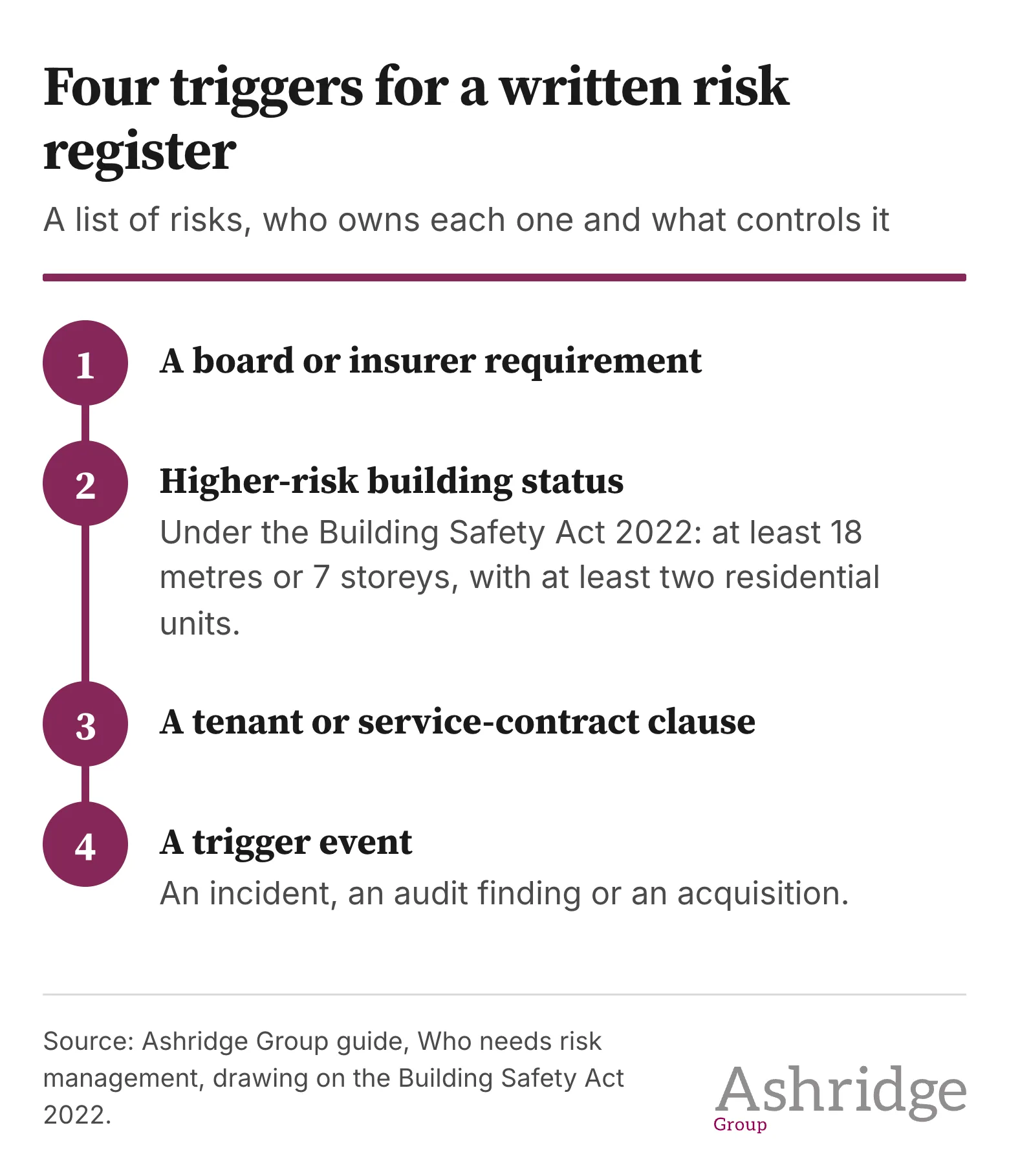
Risk management applies to any UK commercial property where people, premises, data, or operations face material risk. Four drivers usually decide whether a property needs a formal, written risk register (a list of risks, who owns each one and what controls it): a board or insurer requirement; a higher-risk residential building status under the Building Safety Act 2022; a tenant or service-contract clause requiring one; or a trigger event such as an incident, audit finding, or acquisition. Cognitious is the consultancy arm of Ashridge Group. We hold SIA ACS Approved contractor status (SIA reference ELSELISC02, covering security guarding) and are certified to ISO 9001, ISO 14001, and ISO 45001.
We have worked in many of the categories below: a seven-storey higher-risk residential block in Rotherhithe, a theatre in Milton Keynes with audiences of 1,000-plus, a further education college, NHS pharmacies and surgeries, and corporate sites for Sony Europe. We see the triggers from the guarding side. Below, we list the use cases where a written risk register is a legal duty, a contract term, or an audit deliverable, naming the trigger and the output in each. Most registers are built on ISO 31000:2018 or on BS 31100:2021, the current British Standard code of practice, which replaced BS 31100:2011. For wider context, see What is Risk Management and How to Choose Risk Management.
 (opens the full-size image)
Higher-risk residential and mixed-use buildings
The Building Safety Act 2022 defines a higher-risk building in England as one that is at least 18 metres high or has at least 7 storeys, and contains at least two residential units. Mixed-use buildings with residential floors above commercial units are in scope if they meet that height or storey threshold. For an occupied higher-risk building, the principal accountable person must prepare a safety case report on the risks of fire spread and structural failure, and send it to the Building Safety Regulator when asked. The Act does not name BS 31100 or ISO 31000; they are optional frameworks for organising the evidence.
A register can support that evidence by recording each hazard, its controls, an owner, and a review date. The Regulator’s guidance on preparing a safety case report sets out what the report must contain. We covered three blocks at Pageant Steps in Rotherhithe with waking watch during a fire alarm upgrade, and one of them, Calder Court, is a seven-storey higher-risk building. London Fire Brigade made multiple compliance visits and all of them passed. Buildings like that are where a written, owned, dated record earns its keep.
Single-tenant offices, multi-tenant serviced offices, corporate headquarters, retail parks, shopping centres, hotels, restaurants, and entertainment venues are commonly asked for a written risk register by a board, lender, insurer, or licensing authority, although no single law requires one. Triggers include tenancy clauses, acquisition due diligence, crowd density, alcohol licensing under the Licensing Act 2003, and seasonal event profiles. For licensed venues, it helps to map the register to the Act’s four licensing objectives: the prevention of crime and disorder, public safety, the prevention of public nuisance, and the protection of children from harm. We run front of house for Sony Europe at Basingstoke and Weybridge, 24/7, and for seven years, until 2026, put two to four officers on each show at Milton Keynes Theatre. Those two jobs sit at opposite ends of this category.
Logistics, distribution, and industrial
Warehouses, distribution centres, last-mile hubs, and manufacturing sites carry the general duty under the Management of Health and Safety at Work Regulations 1999: employers must make a suitable and sufficient assessment of the risks to their employees and to others affected by the work, and employers of five or more people must record the significant findings (regulation 3). Triggers include high-rack storage, fork-lift interaction, lone-working shifts, and an incident or audit finding. A register that pairs safety, security, and operational risks on a single matrix, with a named owner per shift, is a practical way to hold those findings.
What Does the Law Require Before You Write a Risk Register?
UK law requires employers to make a suitable and sufficient assessment of workplace risks, and to record the significant findings if they employ five or more people (Management of Health and Safety at Work Regulations 1999, regulation 3). It does not prescribe a risk register format. A register is the practical way to record, own, and review those findings.
The same regulation requires an assessment to be reviewed if there is reason to suspect it is no longer valid or there has been a significant change. HSE adds that you should not copy an example assessment and put your name on it, because that would not satisfy the law: it must reflect your own hazards and controls.
Data centres, healthcare, education, and heritage
Data centres, private hospitals, clinics, universities, schools, and listed heritage sites answer to different bodies, so the trigger depends on the sector. The NIS Regulations 2018 (network and information systems security rules) apply to operators of essential services, including in health, and to relevant digital service providers; the government has set out plans to bring data centres into the same framework. The Data Protection Act 2018 applies wherever personal data is held. Health and social care providers are assessed under the CQC assessment framework. The Department for Education publishes non-statutory protective security guidance for education settings. Historic England’s Heritage at Risk programme tracks the condition of heritage sites, but it does not create a legal duty to keep a register.
We have worked in each of these sectors: corporate and data centre security for Experian UK from October 2018 to November 2022, key holding and alarm response for NHS pharmacies and surgeries, campus security for Milton Keynes College, and heritage consultancy at Delapré Abbey.
What this looks like on a real contract: Cognitious, our consultancy arm, delivered a security survey, a strategy, and a 150-page health and safety policy for heritage site security at Delapré Abbey, a Grade II listed, registered battlefield site, followed by two years of ongoing support with a designated Competent Person.
Frequently asked questions
A small commercial property needs a formal register where any of the four drivers apply: a board or insurer requirement, a Building Safety Act 2022 higher-risk residential status, a tenant or service-contract clause requiring one, or a trigger event such as an incident, audit finding, or acquisition. Without a driver, a shorter operational risk note may be enough, but the legal baseline still applies: employers must make a suitable and sufficient risk assessment and, with five or more employees, record the significant findings.
No statute sets a fixed review interval for a commercial risk register. Under regulation 3 of the Management of Health and Safety at Work Regulations 1999, an assessment must be reviewed if there is reason to suspect it is no longer valid or there has been a significant change. Also set a regular schedule, for example quarterly or annually, and review after any incident or audit finding. For higher-risk residential buildings, check the Building Safety Regulator’s guidance on keeping the safety case report up to date.
The author signs to confirm who prepared the register, and the person accountable for the risk signs to accept it: the employer or board sponsor for a workplace, or the principal accountable person for a higher-risk residential building. No law prescribes a signature format, so agree who signs in the engagement terms.
Four items are enough to scope a commercial property engagement: site address and sector; the trigger event or driver; the named accountable person or board sponsor; and the deadline. If you send them to the Cognitious team, we will reply with a proposal that sets out the lead consultant and the standards referenced, such as ISO 31000:2018 and BS 31100:2021.