
There is no standard UK price for mobile patrol. Ashridge Group prices it per contract after a short assessment, not from a rate card, because the cost depends on how many visits you need, how many sites share the patrol route, travel and vehicle time, whether key holding and alarm response are included, and the risk at each site. What you can work out yourself is the floor under any quote: about £15.98 for each hour one officer works, on the National Living Wage, before the vehicle, supervision, insurance, margin and VAT.
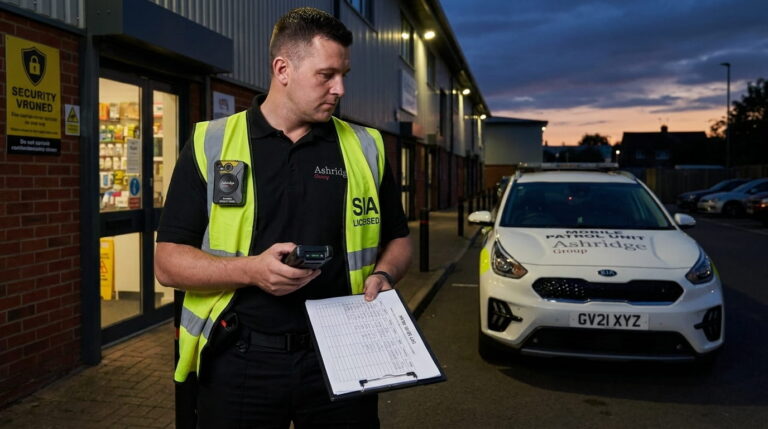
A mobile patrol is a visit by an SIA-licensed officer in a marked vehicle, at scheduled or random times, to check that a site is secure, rather than staying on it like a static guard. The SIA is the Security Industry Authority, the UK regulator for private security. Rates and figures on this page were checked on 11 November 2026.
What drives the price of a mobile patrol contract?
Each driver changes how much officer and vehicle time your contract uses. The first five are the ones our mobile patrols page lists.
- Visits per night. Every visit takes officer time and vehicle time.
- Sites on the route. A patrol round shared across nearby sites keeps the cost per site down.
- Travel and vehicle time. Distance and traffic between your sites set how long a round takes.
- Key holding and alarm response. Whether they are included changes what the officer must be available to do. Key holding is a separate SIA licensable activity.
- Site risk. A riskier site may call for more visits or longer ones.
- Response time and hours. A short response promise generally means fewer sites per officer, because the officer must stay within reach. Ask whether night, weekend and bank holiday visits are priced differently.
Labour is the main cost, and it has a legal floor.
How is the labour cost of a mobile patrol built up?
Start with pay. The National Living Wage for workers aged 21 and over is £12.71 an hour from April 2026. A quote whose labour element works out below that needs an explanation.
Pay is not the whole labour cost. The table is our own arithmetic, not a price. It assumes one officer on the National Living Wage working 40 hours a week for 52 weeks, employer National Insurance at 15% above £5,000 a year (GOV.UK rates for 2026 to 2027), and 5.6 weeks of paid holiday.
| Step | Calculation | Result |
|---|---|---|
| Annual pay | £12.71 × 40 hours × 52 weeks | £26,436.80 |
| Employer National Insurance | 15% × (£26,436.80 − £5,000) | £3,215.52 |
| Hours actually worked | (52 − 5.6 weeks) × 40 hours | 1,856 hours |
| Minimum labour cost per hour worked | (pay + National Insurance) ÷ hours worked | £15.98 |
That £15.98 is a floor, not a price. It leaves out pension contributions, sickness cover, training, vetting, the vehicle, fuel, insurance, supervision, control room time, margin and VAT. From April 2027 the National Living Wage rises to £13.21, and the same arithmetic gives about £16.62.
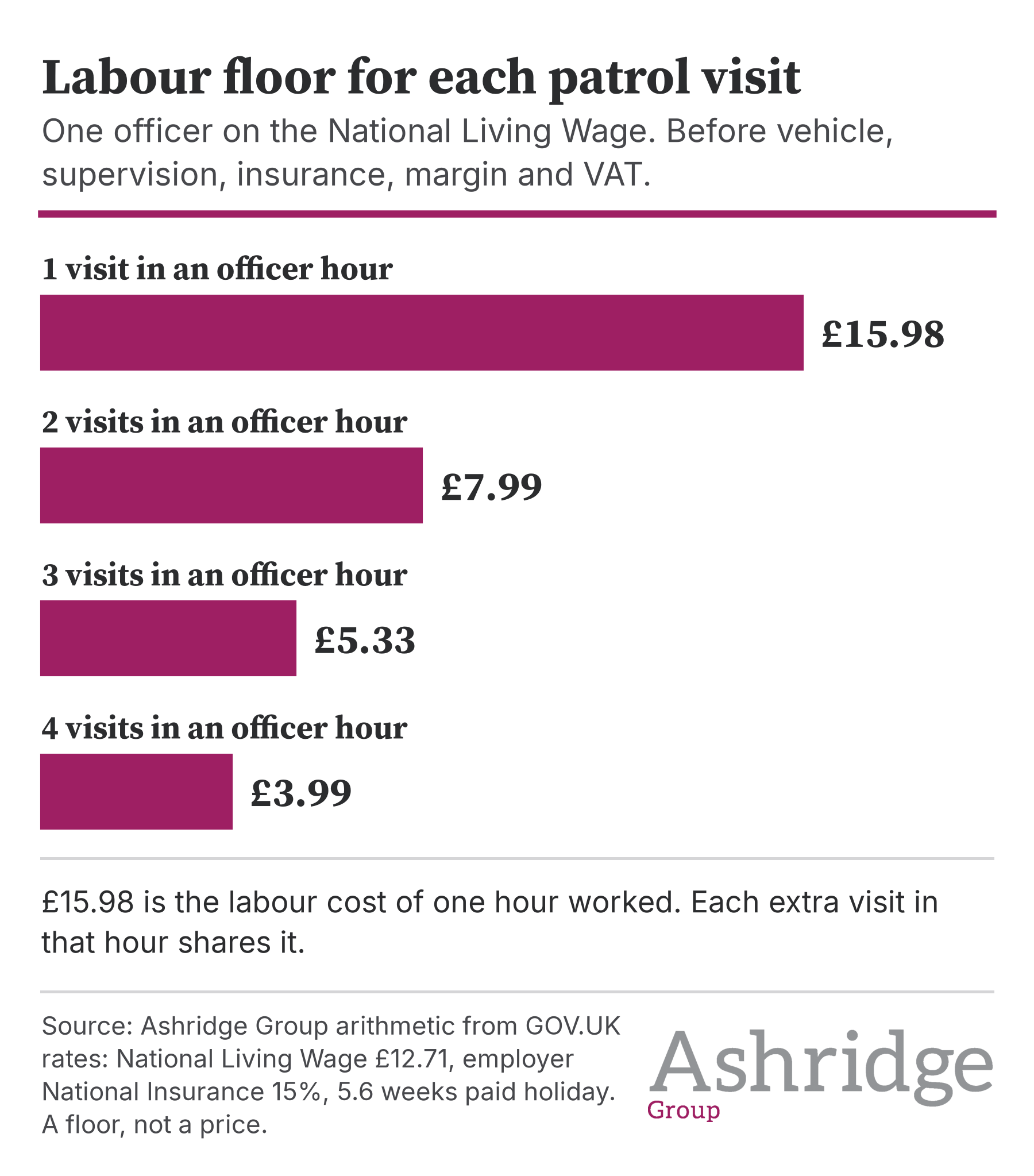
The floor shows why per-visit figures vary so much, because the same hour of labour is split across however many visits the officer completes in it:
| Visits completed per officer hour, including driving | Labour floor per visit (our arithmetic) |
|---|---|
| 1 | £15.98 |
| 2 | £7.99 |
| 3 | £5.33 |
| 4 | £3.99 |
Why are mobile patrol prices hard to compare?
Suppliers quote mobile patrol per visit, per hour or per month, and a figure means little without its basis. A per-visit price needs the visit length in minutes. A monthly price needs the visits per week. Two quotes for the same site can differ because they assume different visit counts, visit lengths, response times and extras. Ask any supplier how many visits it assumes per officer hour. That one number explains most of the gap.
What should a mobile patrol quote show?
Ask for a written quote that shows how the price is built, not a single figure. To get one, send the site address, the number of units or buildings, the hours the patrol must cover, the response time you need and whether you need key holding and alarm response. A good quote then shows:
- the number of visits, the route and the expected length of each visit;
- the response time for alarm activations, and what happens if the officer is busy;
- each extra service (key holding, alarm response, internal checks, supervision) as a separate line;
- the hourly or per-visit basis of the price, and the visits assumed per officer hour;
- whether VAT, fuel and vehicle costs are included;
- the contract term, the notice period and what happens if a visit is missed.
Our guide to what a mobile patrol contract should include covers service levels, service credits and exit terms. For the standards and the checks to make on any provider, see mobile patrol regulations in the UK.
What does the supplier’s accreditation tell you about the price?
Less than the label suggests. The Approved Contractor Scheme (ACS) is a voluntary SIA scheme that approves companies, not people, and you can search its register. Approval is for named activities. Ashridge Group holds ACS approval for security guarding and key holding is a separate licensable activity that this approval does not cover. So ask which activity a supplier is approved for, and check the entry, before you treat approval as a reason for a higher or lower price.
What does this look like on a real contract?
For a number of NHS trusts, Ashridge Group provides 24-hour key holding and mobile response to pharmacies and doctors’ surgeries. Officers responded to multiple incidents, often alarm faults, so staff were not called out overnight or at weekends. The NHS trusts case study has the detail, and the mobile patrols service page explains how the service works. If you are still deciding between a patrol and a guard on site, read manned guarding or mobile patrol: which does your site need.
How do I get a mobile patrol price for my site?
Send Ashridge Group your site details as listed above. We assess the site and propose a patrol schedule, usually within one working day. Call 0800 085 5022 or use the quote form on the mobile patrols page.
Frequently asked questions
Usually, because a patrol round is shared across the sites on its route, while a static guard is paid for every hour on one site. Higher-risk or public-facing sites may still need a guard present. The right choice depends on the risk and the response time you need.
Yes, if they patrol premises against theft or unauthorised access under a contract for services. Key holding is a separate SIA licensable activity. Ashridge Group's officers are directly employed, SIA-licensed and screened to BS 7858.
No. The SIA says taking part in the Approved Contractor Scheme is voluntary. It approves companies, not people, and covers named activities, so check the register entry for the activity you are buying.
The legal floor for labour will rise. The National Living Wage goes from £12.71 to £13.21 an hour, and the same arithmetic as this page gives about £16.62 for each officer hour worked, up from £15.98. Whether your price moves depends on your contract, so ask how pay-rate changes are handled.
Not necessarily. Ask for key holding and alarm response as separate lines, so you can see what each adds. Ashridge Group attends alarms to BS 7984, the standard for key holding and response.