
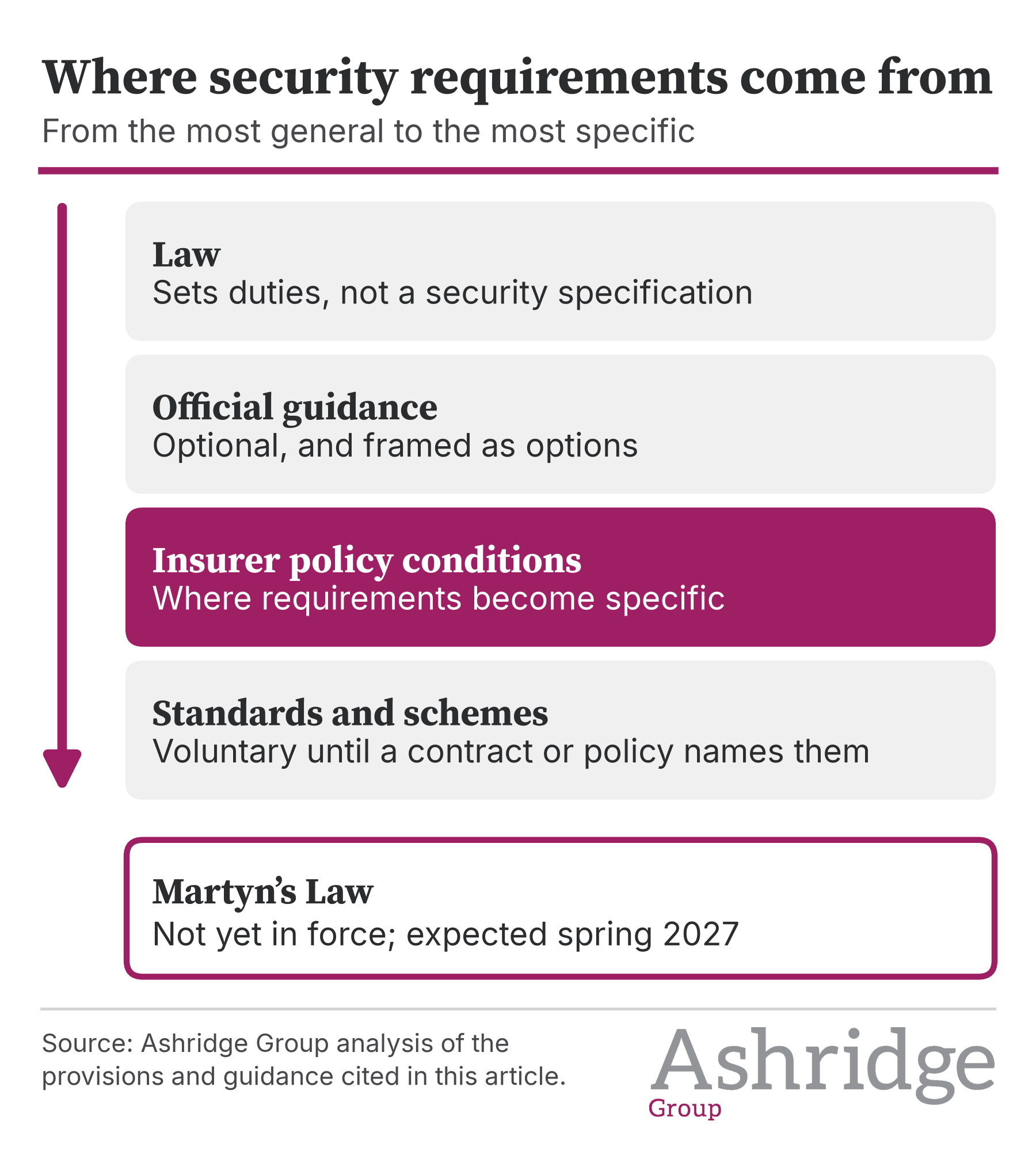
None of the main statutes that apply to commercial premises requires a security guard, an intruder alarm or CCTV. The legal duties are indirect: health and safety law, fire safety law and data protection law all require you to manage access and risk, and Martyn’s Law will add duties for qualifying premises that can hold 200 or more people once it is in force, expected in spring 2027. The requirements that tell you what to fit or staff are usually your insurer’s policy conditions and, if you want the police to attend an alarm, the police rules on keyholders. Each requirement below is labelled as law, official guidance, insurer or standard, or good practice.
What the law requires of a commercial property
The law sets duties, not a security specification. Each row below is a provision we opened, with who holds the duty and how far it reaches into security.
| Law | Who holds the duty | What it says | Reach into security |
|---|---|---|---|
| Health and Safety at Work etc. Act 1974, section 4 | Each person who has, to any extent, control of non-domestic premises or the means of access to them | Take the measures it is reasonable for that person to take to ensure, so far as is reasonably practicable, that the premises, the means of access and egress, and any plant or substance are safe and without risks to health for people who are not your employees and use the premises as a place of work | A safety duty, not a crime-prevention duty. It can reach access control where an open plant room or roof hatch puts a contractor at risk. Your health and safety adviser decides where |
| Regulatory Reform (Fire Safety) Order 2005, article 9 and article 14 | The responsible person (England and Wales) | Make a suitable and sufficient fire risk assessment and review it regularly, in particular if there is reason to suspect it is no longer valid or the premises or organisation change significantly. Keep emergency routes and exits clear. Emergency doors must not be locked or fastened so that they cannot be easily and immediately opened by anyone who may need them in an emergency | Sets a limit on security rather than a requirement for it. Locks and access control must not defeat escape |
| UK GDPR, article 32 | Controllers and processors of personal data | Implement appropriate technical and organisational measures for a level of security appropriate to the risk, taking account of the state of the art, the costs of implementation and the nature, scope, context and purposes of processing | Applies if you hold personal data on the premises. It names no lock, guard or camera |
| Data protection rules on CCTV, as summarised by GOV.UK | A business that uses CCTV | Register with the Information Commissioner’s Office and pay a data protection fee unless exempt, display clearly visible signs, control who can see recordings, and use the system only for its intended purpose | Applies if you fit CCTV. It does not require you to |
| Private Security Industry Act 2001, as applied in SIA guidance | The individual working under a contract for services, such as a guard placed on your site by a security company | An SIA licence is needed for a licensable activity under a contract for services. Manned guarding and key holding are licensable | You do not have to hire guards. If you do, GOV.UK warns that you could be fined or sent to prison for paying someone to work in security without the right SIA licence |
Hiring a contractor does not remove the duty holder’s own duties. The Fire Safety Order places its duties on the responsible person. Under section 4(3) of the 1974 Act, a person with a contractual obligation to maintain or repair premises is treated as having control to the extent of that obligation. Who holds which duty in your building is a question for your legal adviser.
What official guidance suggests
Official guidance on physical security is optional and framed as options. The Information Commissioner’s Office (ICO) physical security toolkit lists options to consider for protecting areas that hold personal data:
- identify and risk assess the areas that need more security, and test the physical controls regularly;
- combine controls at entry points, for example perimeter security with electronic access control;
- keep a record of who has physical access rights, monitor visitor and guest access, and remove access rights in the leavers’ checklist;
- store physical records in lockable rooms or cabinets and record who holds the keys, key cards or codes.
The ICO marks this guidance as under review following the Data (Use and Access) Act, so check the current page before you rely on it.
Insurance conditions are where requirements become specific
Your insurer’s policy is usually the only place that tells you what to fit. Aviva’s published Loss Prevention Standard on doors and windows says that cover against theft may be conditional on a Minimum Security Standard, that these standards tend to concentrate on common locks on typical doors and windows, and that they vary by insurer, type of property and type of contract. So no single list applies to every building. Read the security conditions in your own schedule.
Where a policy relies on an alarm, the British Insurance Brokers’ Association (BIBA) guidance on intruder alarms says an alarm condition may typically require:
- installation, maintenance and any monitoring by an inspectorate-listed company, and a maintenance contract kept in force;
- the insurer to be told of changes to the system, including signalling, and of any reduction or withdrawal of police response;
- the system to be fully set whenever the premises are unattended, with keys, fobs and codes not left on site;
- suitable keyholders to be appointed, and prompt keyholder attendance on any activation or fault.
The same guidance says insurers typically regard a grade 2 system as suitable for lower-risk commercial premises and grade 3 for most commercial premises. Grade 1 is disregarded by insurers.
The keyholder is where an insurer condition and a police rule meet. The National Police Chiefs’ Council (NPCC) requirements for security systems (March 2024 edition; check for a later one) say that premises with a remote-signalling (Type A) system must have at least two keyholders registered with the monitoring centre. A keysafe is not an acceptable alternative. Each keyholder must be trained to operate the alarm, be contactable by telephone, have transport to attend at any hour, have access to all relevant parts of the premises and be able to attend within 20 minutes of being notified. If keyholders fail to attend on two occasions in a rolling 12 months, police response may be withdrawn for three months. The requirements also note that where SIA licensing rules stop a commercial keyholder attending within 20 minutes, alternative keyholders must be registered.
Two practical points follow. Ask any key holding provider to confirm in writing whether it can meet 20 minutes for your postcode. And treat the loss of police response as an insurance event as well as an operational one, since an alarm condition may require you to tell the insurer.
Locks follow the same pattern. Aviva says timber doors are usually secured with a five-lever mortice deadlock or a rim cylinder deadlock, ideally certified to a standard in the BS x621 series. BS 3621:2017+A1:2024 covers thief-resistant locks that are locked from both sides with a key and so allow only key egress. It excludes locks that provide keyless egress. That matters on emergency exits, where the Fire Safety Order requires doors to open easily and immediately. Aviva advises asking the local fire authority or your insurer when an emergency exit door’s security is in doubt.
Standards and schemes: voluntary until a contract or policy names them
British Standards are codes of practice, not law. They bind you only if your policy, lease or contract names one. These are the ones that come up on commercial property.
| Standard or scheme | What it covers | Status |
|---|---|---|
| BS 8243:2021 | Design, installation and configuration of intruder and hold-up alarms that use alarm confirmation, signal to an alarm receiving centre and need a police response | Current. Voluntary code of practice |
| BS 7984-1:2016 | Recommendations for the management, staffing and operation of organisations providing key holding and response services | Current, under review. Voluntary. The NPCC requirements tell customers who use a commercial keyholder to be aware of it |
| BS 7499:2026 | Management, staffing and operation of organisations providing static guarding | Published 31 August 2026. Voluntary |
| Approved Contractor Scheme (ACS) | The SIA’s quality assurance scheme for security companies. Approval is for specific activities, not the whole company | Voluntary. It is a criminal offence to claim approval when a company is not approved |
The distinction that catches buyers is between licences and approval. An SIA licence is a legal requirement for the individual doing the licensable work under a contract. ACS approval is a voluntary assessment of the company. Check both on the SIA registers before you sign: our SIA licensing checklist shows how, and the mobile patrol regulations guide covers the standards for patrols and key holding in detail. Ashridge Group is SIA ACS approved for security guarding only, which does not extend to key holding or any other activity. The awards and accreditations page gives the details and how to check them.
Martyn’s Law: not yet in force
The Terrorism (Protection of Premises) Act 2025, known as Martyn’s Law, is not yet in force. On 11 November 2026 section 1 of the Act was shown on legislation.gov.uk as a prospective provision, and the SIA’s guidance on the Act says it is expected to come into force in spring 2027, with the exact date to be confirmed ahead of time.
The SIA says premises are likely to be in scope if they include a building or part of one, are wholly or mainly used for a purpose listed in Schedule 1 to the Act, are not excluded under Schedule 2, and can reasonably be expected from time to time to hold 200 or more people at once, staff included. Premises that hold between 200 and 799 people fall in the standard tier, which requires the responsible person to notify the SIA and to have appropriate public protection procedures in place so far as is reasonably practicable: evacuation, invacuation, lockdown and communication. The enhanced tier, from 800 people, adds protection measures and documentation. The responsible person is the person or organisation with control of the premises for the purpose that brings them into scope.
Whether your building is in scope depends on its use and the numbers it can hold. That is for you and your adviser to decide against the Home Office guidance the SIA points to. The duty sits with the person in control of the premises. Cognitious, our security consultancy, plans lockdown and evacuation as part of its emergency preparedness work, which is the kind of procedure the standard tier asks for.
Good practice: where to spend first
Nothing in this section is a legal requirement. It is the order in which we would work through a building, and it follows the sources above.
- Read your policy schedule and your fire risk assessment. These are the two documents that bind you. Note every security condition in the first and every constraint on locking and exits in the second.
- Run a security risk assessment. Aviva’s risk factors are a useful starting list: local history of security incidents, what theft-attractive goods are on site and where, fencing and lighting, wall-mounted items or ladders that give access to other entrances, how strong the building is compared with its doors and windows, and any guarding or other human presence. Cognitious provides security threat and risk assessments, and the cost guide explains what drives the price.
- Close the response gap before adding equipment. An alarm with no one reliably attending it fails both the police rule and the insurer’s condition. Ashridge Group provides key holding and alarm response, and holds keys and attends activations 24 hours a day for NHS pharmacies and doctors’ surgeries so that clinical staff are not called out at night: see the NHS trusts case study.
- Control who enters. For a multi-tenant office or mixed-use building, visitor and contractor access control at reception is the measure the ICO options point to: a record of who has access, monitored visitor access, and access removed when people leave. Ashridge Group provides this through corporate security and front of house.
- Add static guarding only where a person must be on site, for example to control a gate or meet visitors. The guarding or patrol comparison sets out when each fits. Ashridge Group’s manned guarding officers are directly employed.
Ashridge Group does not install alarms, CCTV or access control. If your insurer needs an alarm fitted or upgraded, that comes from an inspectorate-listed alarm company. Ashridge Group can arrange remote CCTV monitoring through accredited specialist monitoring partners.
Frequently asked questions
No. None of the main statutes that apply to commercial premises requires a guard, an intruder alarm or CCTV. The legal duties are indirect, through health and safety, fire safety and data protection law. What you must fit or staff is usually set by your insurer's policy conditions.
The insurer material we read concentrates on locks, alarms and keyholders, not guards. A guarding condition, if you have one, will be in your policy schedule or your lease, so read the security conditions in your own schedule.
Data protection obligations: register with the Information Commissioner's Office and pay a data protection fee unless exempt, display clearly visible signs, control who can see recordings, and use the system only for its intended purpose. They apply when you fit CCTV and do not oblige you to fit it.
Not on the alarm alone. The British Insurance Brokers' Association says a 999 call about an unmonitored alarm will only be met if the caller can persuade the police that there is some evidence of criminal activity. Police response is linked to monitored systems that hold a police unique reference number.
At least two keyholders registered with the monitoring centre for a remote-signalling (Type A) system, according to the National Police Chiefs' Council requirements (March 2024 edition). Each must be able to attend within 20 minutes of being notified. A keysafe is not an acceptable alternative.
Not yet. The Terrorism (Protection of Premises) Act 2025 is expected to come into force in spring 2027, according to the SIA, with the exact date to be confirmed. It is likely to apply to qualifying premises that can reasonably be expected to hold 200 or more people at once, staff included.