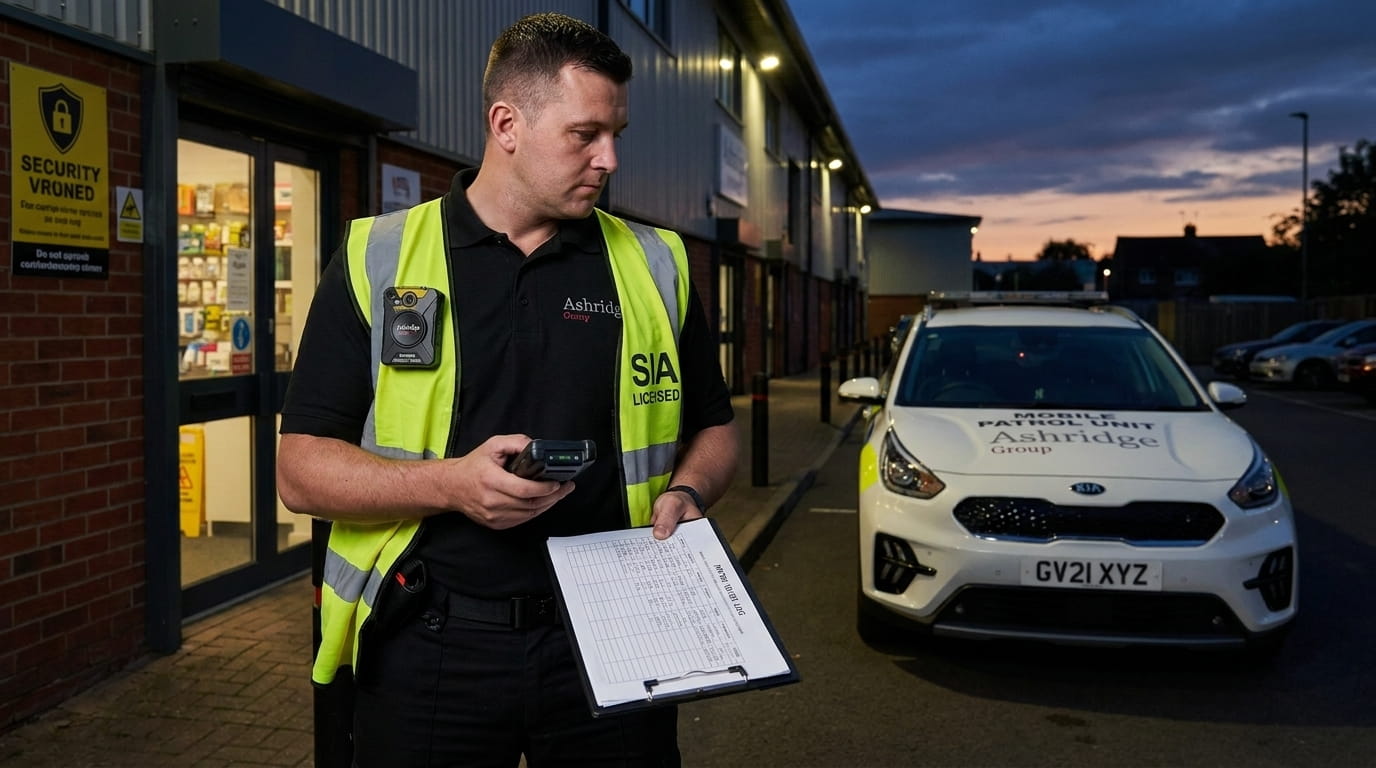

Mobile patrol regulations in the UK are the Security Industry Authority (SIA) licensing rules under the Private Security Industry Act 2001 and the British Standards that describe good practice. BS 7984-3:2020 is the code of practice for mobile security services. BS 7499:2026 covers static guarding, BS 10800:2026 is the general code for security services, and BS 7858:2019 covers officer screening. Only the licensing rules are law. The standards are voluntary, but they are what ACS assessors, insurers and principal contractors look for. We hold SIA ACS Approved contractor status (the SIA’s voluntary Approved Contractor Scheme; ref ELSELISC02), which you can verify on the SIA register.
This page sets out the rules and standards we work to and the checks to make on any provider.
In this guide
- What British Standards Apply to Mobile Patrol?
- How Should Buyers Verify BS 7984-3:2020 Operational Standards?
- Which UK Statutes Set the Scope?
- How Does SIA ACS Scoring Work in Practice?
- Does the SIA Approved Contractor Scheme Apply to Mobile Patrol?
- What Vetting and Training Must Officers Complete?
- What Do BS 7858:2019 and BS 7499:2026 Specify in Detail?
- What Does This Look Like on a Real Contract?
- What Should You Send to Scope a Compliant Mobile Patrol?
- What Statutes Govern SIA Licensing and Insurance Obligations?
- What Due-Diligence Should Buyers Perform Before Appointing a Mobile-Patrol Contractor?
- How Do You Check a Mobile Patrol Provider’s Licences?
- How Should Buyers Identify Red-Flag Claims in Security-Services Marketing?
- How Does the Penalty Doctrine Apply to Missed-Visit Service Credits?
- Example Contract Wording: BS 7858 Five-Year Screening Reference
- Sources
What British Standards Apply to Mobile Patrol?
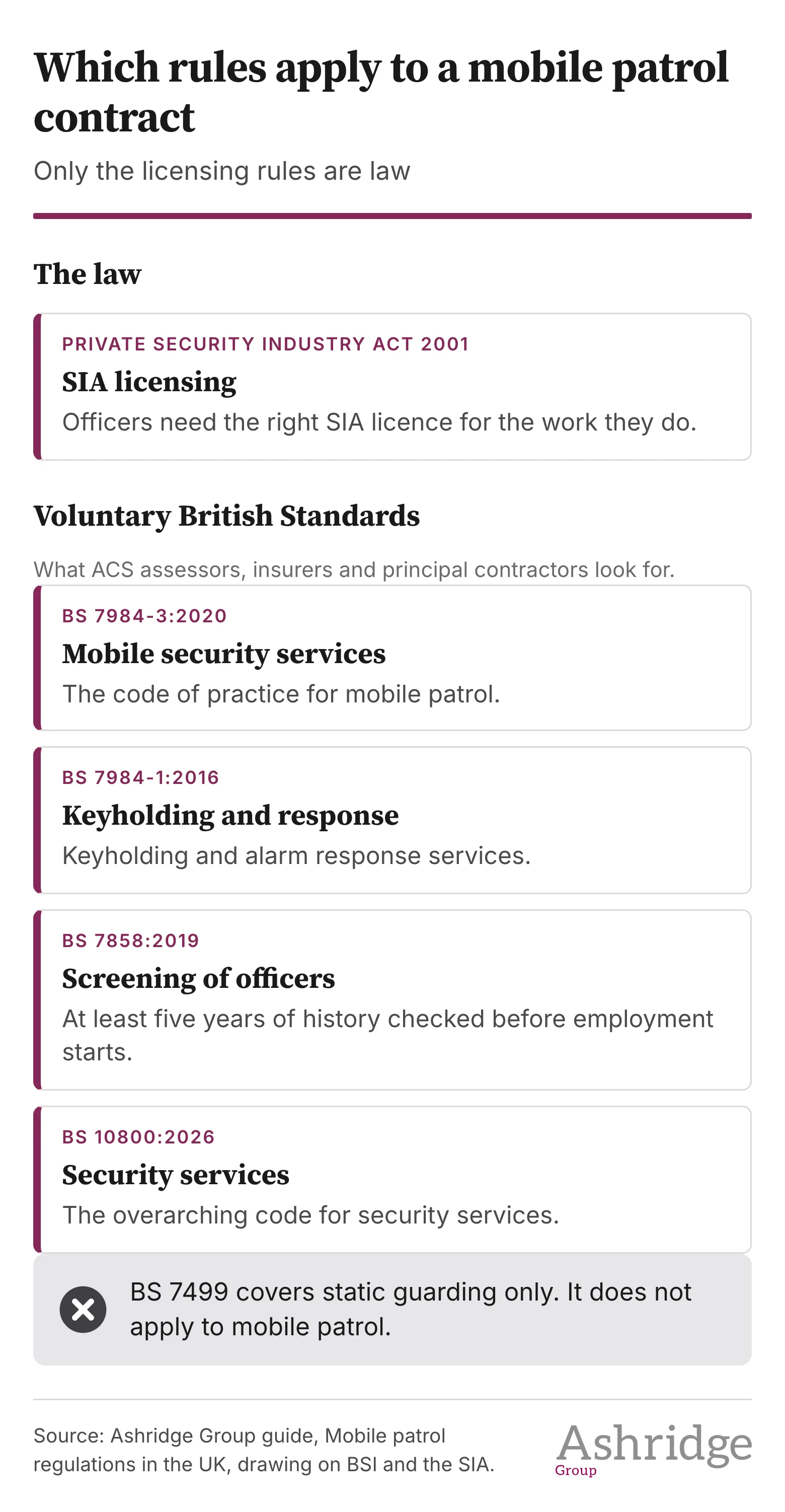
Four British Standards matter most for a mobile patrol contract. BS 7984-3:2020 covers mobile security services. BS 7984-1:2016 covers keyholding and response services. BS 7858:2019 covers screening of officers. BS 10800:2026 is the overarching code for security services. BS 7499 covers static guarding only and does not apply to mobile patrol.
BS 7499:2013 once covered static guarding and mobile patrol in one document. BSI split it in 2020, and BS 7984-3:2020 and BS 7499:2020 together superseded the 2013 edition. BSI has since published BS 7499:2026 and BS 10800:2026 (31 August 2026) and withdrawn the 2020 editions of those two. BS 7984-3:2020 is shown as current on BSI’s website.
BS 7858:2019 sets the screening standard. The screening period is at least five years before employment starts (or back to age 16 if that is more recent), and ten years where a longer period is required. It covers identity, right to work, full address history for five years, public-record searches (such as bankruptcies, court judgments and financial sanctions), a criminality check, and verification of employment history with no unverified period longer than 31 days.

 (opens the full-size image)
How Should Buyers Verify BS 7984-3:2020 Operational Standards?
Ask the provider to show how it meets BS 7984-3:2020, and do not accept a bare statement. BSI describes the code as recommendations for the management, staffing and operation of an organisation providing mobile patrol services. Request the risk assessment behind your visit frequency, a sample patrol report, and the check-call and missed-visit procedure.
Visit frequency and check calls should be set from documented security and health and safety risk assessments for your site, and not from a standard interval. There is no single UK patrol interval, and we have not found one in any primary source. Treat any provider that quotes a fixed interval without reference to your risk assessment with caution. Separate NFCC guidance on a waking watch in residential buildings defines it as staff continually patrolling all floors and the exterior of a building as a temporary fire-safety measure. That is a different service from private security patrol and should be specified separately.
BS 7984-1:2016 gives recommendations for keyholding and alarm response: how keys are secured, how the organisation responds to an activation, and how it attends, investigates and makes premises secure. We provided key holding and alarm response alongside manned guarding at Milton Keynes Theatre for seven years, so this is a code we work with. It is a code of practice, so response times are a matter for the contract. Ask the provider to state the response time it will commit to for your site, how it measures it, and what happens when it is missed. A certification body such as NSI can audit a provider against these codes, which gives you independent evidence beyond the provider’s own statement. BS 8584 is the standard for vacant property protection, not keyholding.
Which UK Statutes Set the Scope?
The Private Security Industry Act 2001 is the main statute. It created the Security Industry Authority and makes it an offence to carry out licensable conduct without a licence. Patrol is covered expressly: Schedule 2 says guarding includes “any form of patrol or surveillance” that deters or reports on theft, damage or unauthorised access. A contracted mobile patrol officer therefore needs an SIA licence.
We are SIA ACS approved (ref ELSELISC02) and hold ISO 9001, ISO 14001 and ISO 45001 certification. Our officers are directly employed and SIA-licensed. Whichever provider you use, every officer deployed under a contract for services must hold a current licence, so ask for licence numbers and check them on the SIA register.
The Management of Health and Safety at Work Regulations 1999 require every employer to make a suitable and sufficient assessment of the risks to employees and to others affected by the work (regulation 3). That sits under the duty of care in the Health and Safety at Work etc. Act 1974. UK GDPR and the Data Protection Act 2018 govern personal data such as body-worn camera footage, patrol reports and incident logs held on the buyer’s behalf.
How Does SIA ACS Scoring Work in Practice?
The SIA assesses approved contractors against 78 indicators grouped under seven criteria: strategy; service delivery; commercial relationship management; financial management; resource management; people; and leadership. Approval is pass or fail, with no gold or silver levels. Alongside that, each contractor receives a score, and the SIA publishes average scores by company size.
The pass mark for each indicator is the required achievement level, and a positive score shows a contractor doing more than the minimum. Most approved contractors score themselves against the ACS standard every year, and independent assessors verify the scores. Approved contractors have an annual assessment, and the SIA can withdraw approval if a company stays below the standard.
Approved contractors appear on the SIA register of approved contractors. Approval is for specific activities and not for the company as a whole, so check that security guarding appears for the work you want. It is a criminal offence for a company to claim approved contractor status when it is not approved, including by displaying the ACS mark.
Does the SIA Approved Contractor Scheme Apply to Mobile Patrol?
Yes, in the way that matters to buyers. Mobile patrol that guards premises or property is licensable security guarding, and the Approved Contractor Scheme covers security guarding as an approved activity. The scheme is voluntary, so ACS approval is a quality mark and not a legal requirement. We hold ACS approval (ref ELSELISC02) for security guarding.
ACS approval is not statute, but many principal contractors and public-sector buyers expect it. Confirm the contractor’s approval status and approved activities on the public SIA register before you sign.
What Vetting and Training Must Officers Complete?
Every officer on a contracted patrol must hold a current SIA licence for the work, normally a security guard licence, plus a key holding licence if they keep or control access to keys. BS 7858:2019 screening applies as well: the SIA requires approved contractors to conform to it, and an organisation should not confirm employment until full screening is complete.
Top-up training should cover site-specific hazards, reporting templates, escalation routes and body-worn camera use where it is deployed. Ask the provider for the training matrix and the named lead before you sign. Site-specific briefing matters on every contract. At Milton Keynes College, a client from 2015 to 2023, we provided manned guarding, key holding and patrols, in and out of term time, working in conjunction with Thames Valley Police. See campus security for Milton Keynes College.
What Do BS 7858:2019 and BS 7499:2026 Specify in Detail?
BS 7858:2019, Screening of individuals working in a secure environment, requires a screening period of at least five years, or ten years where a longer period is required, with no unverified period over 31 days. BS 7499:2026 covers static guarding only, so it does not replace BS 7984-3:2020 for mobile patrol.
Under BS 7858:2019, five-year screening should be completed within 12 weeks of conditional employment starting, and ten-year screening within 16 weeks, with limited extensions that top management must approve and record. The standard also asks for the individual’s SIA licence number and expiry date, where held. The National Security Inspectorate (NSI) uses BS 7858 as the basis for auditing screening processes, and the SIA uses it as the benchmark for approved contractors.
BS 7499:2026 is titled “Provision of static guarding security services: Code of practice” and supersedes BS 7499:2020, which BSI withdrew on 24 August 2026. BS 7499 covers static guarding operations, control rooms, site records and key management. Specify mobile patrol routes, visit verification and incident handling against BS 7984-3:2020. The distinction matters to you as a buyer: audit a static post against BS 7499 and a patrol service against BS 7984-3.
A mobile patrol contract should be specified against BS 7984-3, and the patrol work is licensable security guarding under the Private Security Industry Act 2001 (see the SIA guidance on who needs a licence).
What Does This Look Like on a Real Contract?
On a real contract, key holding and mobile response means 24-hour cover that deals with incidents overnight so your staff are not called out. We provide that for NHS pharmacies and doctors’ surgeries, as key holding and alarm response for NHS sites.
It is the keyholding and response territory covered by BS 7984-1 and the SIA key holding licence described above.
What Should You Send to Scope a Compliant Mobile Patrol?
Five items are enough for a provider to prepare a BS 7984-3:2020-aligned mobile patrol specification and quotation. First, the site address and premises type. Second, the operating hours required and any weekend or out-of-hours coverage for the perimeter. Third, the visit frequency and any alarm-response expectation.
Fourth, the reporting cadence and recipient. Fifth, any insurance or principal contractor requirements for your sector. See the mobile patrol service page and the mobile patrol contract terms guide.
What Statutes Govern SIA Licensing and Insurance Obligations?
SIA guidance says a licence is required where work is part of a “contract for services” and involves a “licensable activity”. The licensable activities are manned guarding, key holding and (in Northern Ireland only) vehicle immobilisation. Manned guarding has five licence types: security guard, door supervisor, public space surveillance (CCTV), close protection, and cash and valuables in transit. Key holding has its own licence, which comes as a letter rather than a photocard.
Manned guarding means guarding premises against unauthorised access, occupation, disorder or damage, guarding property against damage or theft, or guarding individuals against assault or injury. Staff employed in-house do not usually need a licence, apart from door supervision at licensed premises. Mobile patrols that guard premises or property for a client are therefore security guarding. Officers on a patrol contract must hold the appropriate licence, and approved contractors are listed on the SIA register as approved for security guarding. The Act itself is on legislation.gov.uk.
Private Security Industry Act 2001: offences and penalties
The Private Security Industry Act 2001 establishes the Security Industry Authority and creates offences related to licensable conduct. Section 3 makes it an offence to engage in licensable conduct without a licence, punishable on summary conviction by up to six months’ imprisonment, a fine not exceeding level 5 on the standard scale, or both. Section 5 makes it an offence to provide security industry services by means of an individual who is engaging in licensable conduct without a licence. It carries up to six months or a fine on summary conviction, and up to five years or a fine on indictment.
Section 5 offers two defences: the provider did not know, and had no reasonable grounds to suspect, that the individual was unlicensed, or it took all reasonable steps to make sure they were licensed. The SIA also warns that buyers can be fined or imprisoned for paying someone to do security work without the right licence. These provisions are a sound basis for contract terms that treat deployment of unlicensed staff as grounds for termination or remediation.
Insurance structure for mobile-patrol and guarding contracts
Employers must carry employers’ liability insurance of at least £5 million under the Employers’ Liability (Compulsory Insurance) Act 1969 and the Employers’ Liability (Compulsory Insurance) Regulations 1998. Public liability and professional indemnity cover are matters for the contract, and sensible limits depend on the site, the contract value and any tender specification, so no standard range applies.
If you are buying mobile-patrol services, ask the contractor for its insurance schedule and confirm the public liability, employers’ liability and professional indemnity limits against what the contract or tender requires. Check the policy period and any exclusions as well as the headline figure.
What Due-Diligence Should Buyers Perform Before Appointing a Mobile-Patrol Contractor?
Before you enter a mobile-patrol contract, run basic corporate and regulatory checks. Companies House data confirms the contractor’s legal identity, registered office, incorporation date and nature of business. We are registered as Ashridge Group Ltd under company number 08129423 with SIC code 80100 (private security activities). The SIA register of approved contractors confirms ACS reference numbers and the activities approved, and we are listed under reference ELSELISC02 for security guarding.
Ask for ISO 9001, ISO 14001 and ISO 45001 certificates where a provider claims them, and check the scope printed on each. For personnel screening, ask for the provider’s BS 7858:2019 screening procedure and anonymised examples showing five-year history verification, address-history checks and public-record searches. Ask for the insurance schedule showing public-liability, employers’-liability and professional-indemnity limits relevant to mobile patrol and keyholding.
How Do You Check a Mobile Patrol Provider’s Licences?
Use two free SIA searches. Search the register of approved contractors to confirm the company’s ACS approval and the activities it covers. Then search the Register of Licence Holders for individual officers, using the 16-digit licence number or the surname plus other personal details. Most front line licences are photocards; the key holding licence is a letter.
- Ask the provider for its ACS reference and the names or licence numbers of the officers who will patrol your site.
- Check the company on the SIA register of approved contractors and confirm security guarding is listed.
- Check each officer on the Register of Licence Holders and confirm the licence type matches the work (security guard, plus key holding if keys are held).
- Repeat the check when officers change. The SIA guidance on checking security staff explains how.
How Should Buyers Identify Red-Flag Claims in Security-Services Marketing?
Be cautious when you read a contractor’s claims about standards and accreditations. A contractor that advertises BS 7858 or BS 7984 compliance but cannot provide independent audit evidence, such as NSI certification, an ACS assessment report or a certification-body letter, may not have systems aligned with those standards. The SIA can supply a contractor’s ACS assessment report if the contractor gives permission, so ask for consent. A contractor that claims ACS status but does not appear on the SIA register for the claimed activity should be treated as non-ACS, and claiming approval falsely is a criminal offence.
Other red flags are unverifiable insurance limits, such as public-liability cover well below tender requirements or no employers’-liability documentation, and claims that screening “follows BS 7858” without evidence of five-year history verification, address-history checks and public-record searches. Insist on sight of certificates, schedules and sample screening records, and reference the specific standards and statutory duties in the contract, including Private Security Industry Act 2001 licensing provisions and BS 7858:2019 screening.
How Does the Penalty Doctrine Apply to Missed-Visit Service Credits?
The Supreme Court judgment in Cavendish Square Holding BV v Makdessi and ParkingEye Ltd v Beavis [2015] UKSC 67 restated the English law test for penalty clauses. The question is whether the clause imposes a detriment on the contract-breaker out of all proportion to the innocent party’s legitimate interest in enforcing the primary obligation. Only secondary obligations triggered by breach can be penalties, not primary obligations such as price adjustments BAILII judgment.
A service credit can be drafted as a price adjustment that reduces future charges when performance falls below an agreed threshold, or as a payment triggered by a specific breach. A credit expressed as a proportion of the monthly fee, with a reasonable cap and a clear link to your interest in reliable service, is easier to defend than a flat sum per missed visit that bears no relation to contract value or likely loss. Wording matters, and both sides should take legal advice on the clause before signing.
Example Contract Wording: BS 7858 Five-Year Screening Reference
A mobile-patrol or guarding contract can incorporate BS 7858:2019 screening expectations with precise wording. Based on the standard’s recommendations, a clause might state: “The contractor shall screen all security officers deployed under this agreement in accordance with BS 7858:2019. Screening shall cover, as a minimum, a continuous five-year period (or ten years where required), verified with no unverified period greater than 31 days, together with full address history for the previous five years, right-to-work checks, identity verification, public-record searches and a criminality check. Screening shall be completed within twelve weeks of conditional employment starting for five-year screening, and sixteen weeks for ten-year screening.”
This reflects the minimum screening period, history verification, address-history requirement and completion times in BS 7858:2019, without overstating statutory obligations. Take legal advice before you adopt contract wording.
If you want a second opinion on a mobile patrol specification or quote, we can read it against BS 7984-3:2020 and tell you what it leaves out. Call 0800 085 5022 or email [email protected].
Sources
- Private Security Industry Act 2001 (legislation.gov.uk)
- Management of Health and Safety at Work Regulations 1999 (legislation.gov.uk)
- Find out if you need an SIA licence (GOV.UK)
- Check security staff have a licence to work (GOV.UK)
- BS 7984-3:2020 (BSI)
- National Security Inspectorate (NSI)
- Cavendish Square Holding BV v Makdessi and ParkingEye Ltd v Beavis [2015] UKSC 67 (BAILII)
Frequently asked questions
The SIA security guard licence covers patrol and guarding. Key holding is a separate licence, needed for security work that involves keeping, or controlling access to, any key. An officer who holds keys and responds to alarms therefore needs a key holding licence as well. BS 7984-1:2016 applies when the contract includes keyholding and alarm response. Ask any provider to confirm it holds both licences or uses a licensed keyholder partner.
No. British Standards are voluntary codes of practice, not statute. Principal contractors, insurers and ACS assessors often expect providers to follow them. BS 7984-3:2020 and BS 7499:2020 together superseded BS 7499:2013; BS 7499:2020 has since been replaced by BS 7499:2026, while BS 7984-3:2020 remains the current edition on BSI's website. Ask any provider which edition it works to.
Employers' liability insurance must, by law, provide at least £5 million of cover under the Employers' Liability (Compulsory Insurance) Act 1969. Public liability and professional indemnity limits are for the contract or tender to set, so check them against your own requirements. Ask for the certificate of insurance and confirm the limits, policy period and any excess before you sign.