
Run the licence and approval checks first, then choose between the suppliers that pass on four things you can test before you sign: who will actually staff your site, whether the hourly rate adds up, what insurance sits behind the contract, and how cover is relieved and supervised. The Security Industry Authority (SIA) licenses individual officers and, separately, approves companies on a voluntary basis. Our SIA licensing checklist explains how to check both, and this guide starts where it stops. It is written for buyers of guarding, the service Ashridge Group’s manned guarding team delivers.
What SIA approval tells you, and what it does not
The SIA’s Approved Contractor Scheme (ACS) approves companies, where licensing covers people. Participation is voluntary, approval is for specific activities and not the company as a whole, and it is pass or fail, with no gold, silver or bronze levels. Search the SIA register of approved contractors for the activity you are buying. Ashridge Group is approved for security guarding. Key holding is a separate activity, and the SIA cannot approve a company for consultancy or alarm installation because it does not license them. It is a criminal offence to claim approval a company does not hold, including by displaying the ACS mark, so check any bidder that shows the mark.
Most approved contractors score themselves against 78 indicators each year, and independent assessors verify the score. The SIA says a score indicates overall quality but not the whole story, because a company can score high overall and poorly in one area. It suggests also weighing reputation and the quality of the tender response, and reading the contractor’s assessment report, which the SIA can give you if the contractor allows it. The maximum is 145. Between 1 October 2025 and 30 September 2026 the median initial annual score was 82 for contractors with 26 to 250 licensable staff, and the SIA bands its averages by size, so compare a bidder with firms of its size.
If a supplier is not approved, make the SIA’s checks yourself
Some suppliers will not hold approval. The SIA’s buyer guide, Do you buy security?, lists what to check instead. Confirm that directors, managers, supervisors and officers are all licensed. Ask for audited accounts (unless the business is new), a PAYE scheme and VAT registration. Verify accreditation marks and testimonials independently. Check employment conditions: National Living Wage, holiday, sick pay and working time. Read the Companies House filings to see whether the company is a “phoenix”, and who its past directors and shareholders were. Ask about audit practice, including out-of-hours spot checks that officers are on site.
Screening is the check an unapproved supplier is least likely to evidence. Approved contractors must conform to BS 7858, the screening standard, to keep their approval. From any other supplier, ask to see its screening procedure.
Ask who will actually be on your site
Subcontracting is common in private security. Approved contractors may subcontract only to other approved contractors unless the SIA has given special permission. Ask in the tender whether the officers are employed by the company bidding or supplied by someone else, and who holds their training and licence records. The SIA’s guide also asks whether the business you contracted with is the one supplying the service, and who the officers believe they work for. Make the contract state when subcontractors or labour providers may be used.
Ashridge Group’s security officers are directly employed on all work, so the company that signs your contract is the one that briefs and manages the officer on your gate. Treat that as a claim to test: ask for the names and licence numbers of the assigned officers before the first shift and compare each with the person on duty, as the checklist describes.
Convert every quote to an hourly rate before you compare
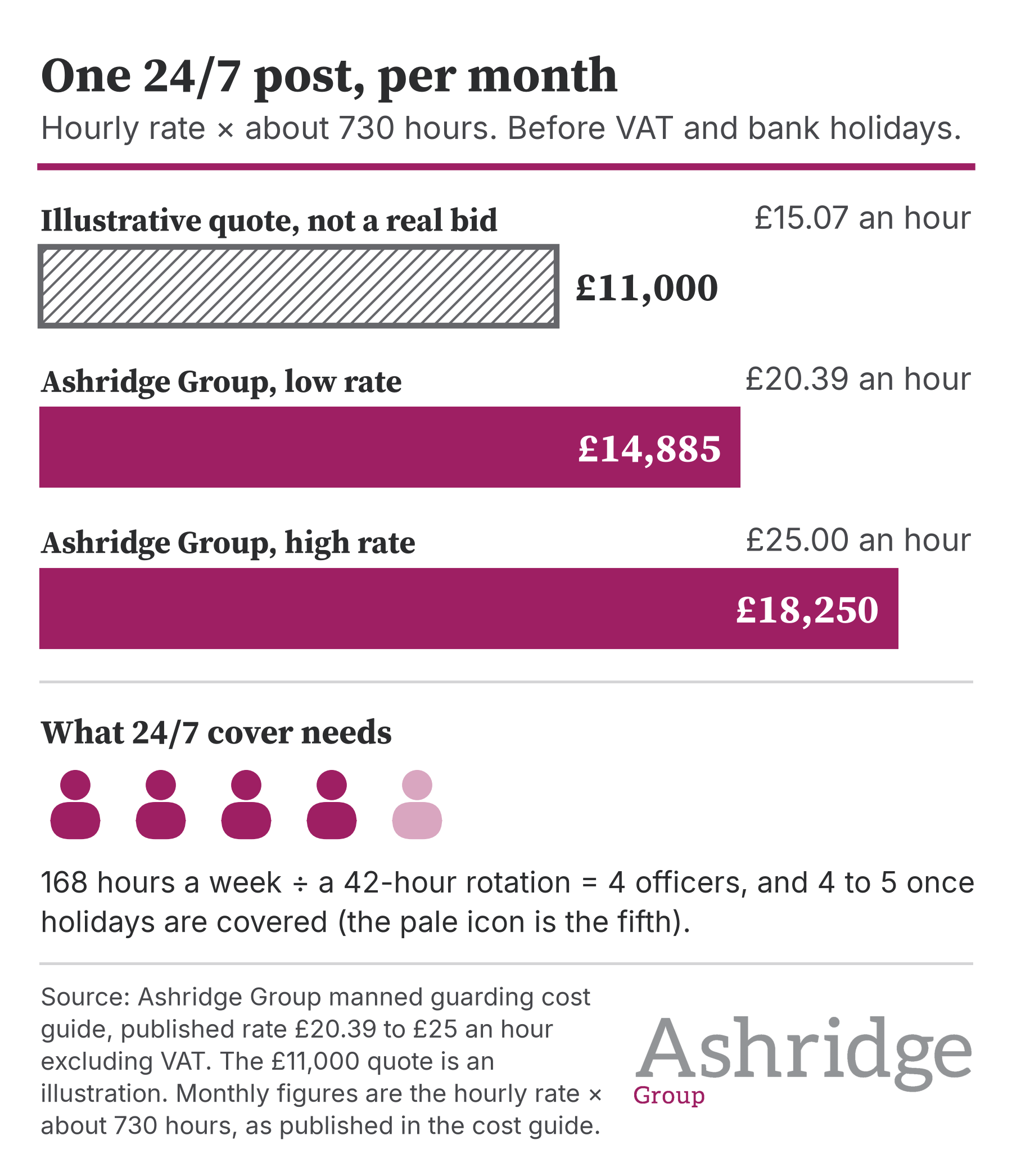
Turn each quote, whether per month, post or shift, into an hourly rate for the same hours: multiply weekly hours of cover by 4.345 to get hours a month, then divide the monthly price by that figure. A post covered 24/7 is 168 hours a week, which is 729.96 hours a month. Ashridge Group’s published rate of £20.39 to £25 an hour, excluding VAT and before bank holidays, gives £14,885 to £18,250 a month for that post, and £14,885 ÷ 729.96 returns £20.39. A quote of £11,000 a month for the same cover would work out at £15.07 an hour (an illustrative figure, not a real bid).
Our manned guarding cost guide says a rate below about £19 to £20 an hour struggles to cover legal staff costs, overheads and a modest profit. The SIA’s buyer guide says very low hourly rates for security may indicate a breach of legal requirements, which can affect insurance cover. A low outlier is therefore a prompt to ask what has been left out. Ask what the rate includes: pay, holiday pay, National Insurance, insurance, uniform, vetting, training, supervision and account management (the list in our cost guide).
Then check the staffing behind the price. On a rotation averaging 42 hours a week, a 24/7 post needs four officers (168 ÷ 42), and four to five once holidays are covered. A bid that prices 24/7 cover with fewer officers has to explain how, so ask which rotation was priced and who covers sickness and holidays. Compare blended rates: the cost guide notes that many providers add a premium for nights and weekends, and Ashridge Group charges bank holidays at double.
Make a site visit a condition of receiving a quote. A price given without one is a guess. Ashridge Group can survey a site and propose cover, usually within one working day.
Insurance: ask for the certificates and set the limits yourself
Employers must hold employers’ liability insurance of at least £5 million from an authorised insurer, and must display the certificate where employees can access it, which can be on a website or intranet (GOV.UK, Employers’ liability insurance). Ask for it with the expiry date. That rule covers employers’ liability only. Public liability is a contract term you set, sized to the realistic cost of a loss at your site, and professional indemnity matters if the company will advise on your security arrangements as well as provide officers. Check that each policy covers your site type and the officers’ activities, and ask your own insurer whether it sets conditions for your supplier.
Ashridge Group sends its current certificates and insurance schedule on request (see our awards and accreditations page).
Test continuity: relief cover, supervision and who manages the contract
Ask for officer turnover over the last 12 months, who covers sickness and leave and whether they have been briefed on your site, who supervises, who the named contract manager is and how often they visit, and what happens out of hours. The SIA’s guide suggests inviting shortlisted bidders to present, and visiting a customer receiving a similar service.
Ashridge Group puts a 24/7 control room, relief cover and a named contract manager behind every security contract. Three contracts show what to ask any bidder to describe:
- Tenure. Ashridge Group has managed front of house security and reception for Sony since 2017, with a 24/7 front desk and out-of-hours cover. The team earned an internal Sony award.
- Takeover. On the A14 Cambridge to Huntingdon scheme, Ashridge Group took over 24/7 manned guarding across 14 fixed and moveable compounds in June 2019, after the incumbent contractor had failed.
- Scale and supervision. For Experian UK, from October 2018 to November 2022, a team of 22 officers led by one security supervisor and one security manager covered two Nottingham sites, and a 24/7 control room managed access control for 20 Experian locations.
Ask for the same detail from every bidder: the client, the sites, the cover hours, how long the contract ran and who supervised it.
Switching provider: TUPE and mobilisation
If you are replacing an incumbent, the SIA’s guide asks buyers to make sure both providers follow TUPE, the rules that move an existing team to the new employer. Ashridge Group manages the TUPE transfer of an existing guarding team and typically mobilises within 24 hours of instruction. Ask every bidder for its handover plan.
Put the answers in the contract
Write down what you were told: hours and officers per post, the rotation priced, whether subcontractors may be used, access to licence and screening records, replacement of any officer whose licence lapses, written assignment instructions, reporting, the contract manager and review meetings, and exit and handover terms. Our guide to what a mobile patrol contract should include sets out service levels, service credits and exit clauses. It was written for patrol contracts, so use it as a template and agree figures with your solicitor.
How Ashridge Group answers the same checks
| Check | Ashridge Group’s answer | How to verify |
|---|---|---|
| SIA approval | Approved Contractor for security guarding, reference ELSELISC02 | SIA register of approved contractors; our accreditations page |
| Who is on site | Security officers are directly employed on all work, SIA-licensed for their role and screened to BS 7858 | Officer names and licence numbers before the first shift |
| Quote | Site survey before pricing, usually within one working day; hourly rates published in the cost guide | Convert our quote and any other to an hourly rate |
| Insurance | Certificates and insurance schedule on request | The insurance schedule itself |
| Quality systems | ISO 9001, ISO 14001 and ISO 45001 (Alcumus ISOQAR); Safecontractor | Certificates on request |
| Public sector buying | Supplier on Crown Commercial Service agreement RM6264, which runs until February 2029 | Crown Commercial Service |
| Continuity | 24/7 control room, relief cover, named contract manager | The three case studies above |
Two limits apply. Ashridge Group’s ACS approval is for security guarding, so check the register for any other activity you buy. Ashridge Group does not install CCTV or alarms, and arranges monitoring through specialist partners, so a buyer who needs installation needs a different supplier.
Frequently asked questions
Check the SIA licence and approval position first: whether the company holds Approved Contractor Scheme (ACS) approval for the activity you are buying, and whether each officer is licensed. Then compare suppliers on who will staff your site, whether the hourly rate adds up, what insurance sits behind the contract, and how cover is relieved and supervised.
Convert every quote to an hourly rate for the same hours. Multiply weekly hours of cover by 4.345 to get hours a month, then divide the monthly price by that figure. A 24/7 post is 168 hours a week, or 729.96 hours a month. Ashridge Group's published rate of £20.39 to £25 an hour, excluding VAT, gives £14,885 to £18,250 a month before bank holidays.
No. The scheme is voluntary. If a supplier is not approved, make the SIA's checks yourself: licences for directors, managers, supervisors and officers, audited accounts, PAYE and VAT registration, independent checks of accreditation marks, employment conditions and Companies House records.
Approved contractors may sub-contract only to other approved contractors unless the SIA has given special permission. Ask in the tender who employs the officers, and have the contract say when sub-contractors may be used. Ashridge Group's security officers are directly employed on all work.
Employers must hold employers' liability insurance of at least £5 million. That rule covers employers' liability only. Public liability is a contract term you set, sized to the realistic cost of a loss at your site, and professional indemnity matters if the company will advise on your security. Ask for the certificates and expiry dates.
Ask for each officer's name and licence number before the first shift. Check it on the SIA register of licence holders, using the 16-digit licence number or the surname plus other personal details, and compare it with the person on duty.
Yes. Make a site visit a condition of receiving a quote, because a price given without one is a guess. Ashridge Group can survey a site and propose cover, usually within one working day.